Thymosin alpha-1 (Tα1) peptide: sequence, how it is supplied, COA, sizes
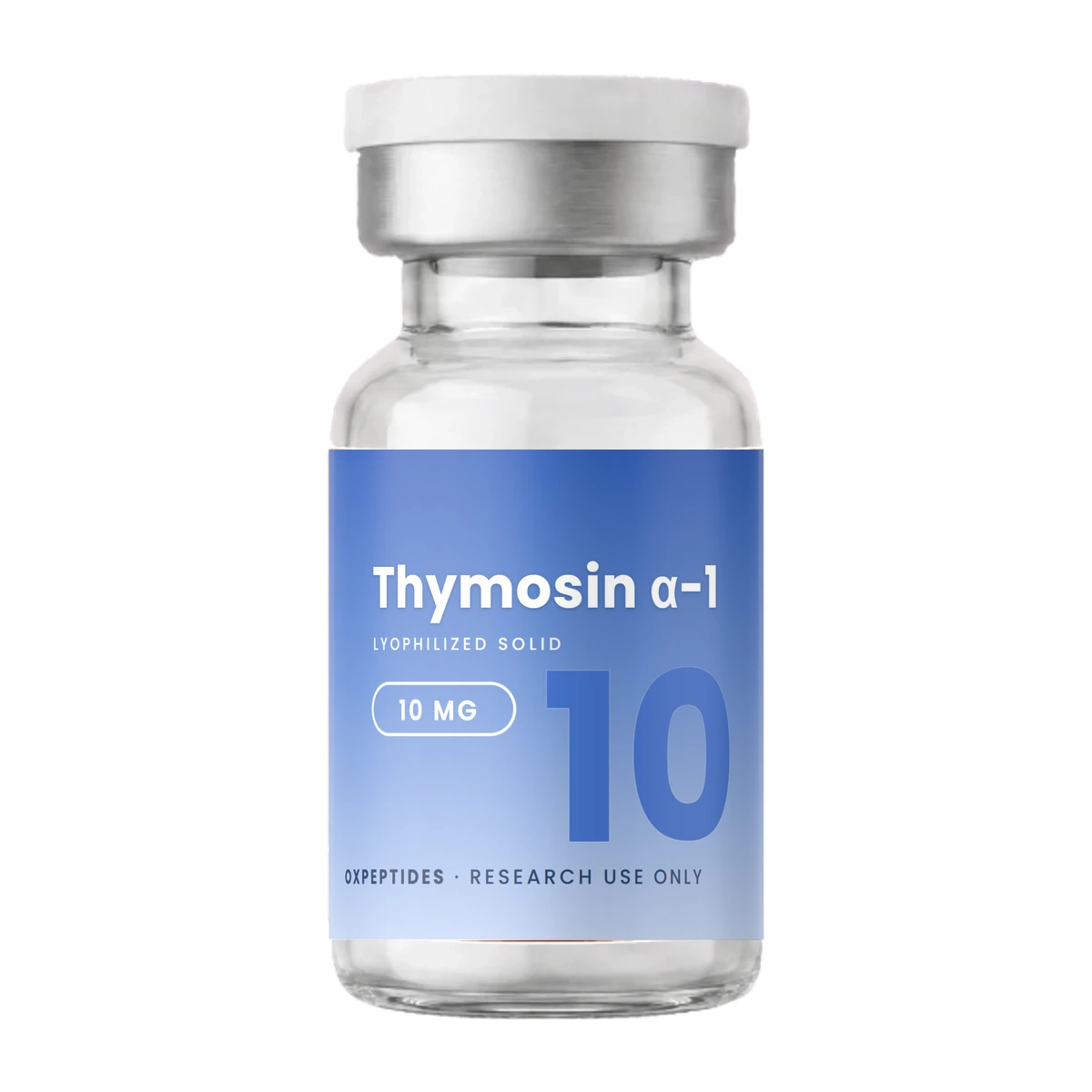
In the catalog
Thymosin α-1
from $89.25subscription −15%, or $105 one-time
Purity >99% by HPLC — measured value on each lot's COA
| Size | Subscription | One-time | Per mg |
|---|---|---|---|
| 10 mg | $89.25 | $105 | $8.93/mg |
Research use only. Not for human or veterinary use. Availability is on the product page.
Thymosin alpha-1 (Tα1) is a synthetic 28-amino-acid peptide, N-terminally acetylated, identical to a fragment of the thymic protein prothymosin alpha; its international name is thymalfasin, mass 3,108.3 g/mol. It is supplied as a white lyophilized powder in a sealed 10 mg vial with a batch certificate of analysis (HPLC purity, mass spectrometry identity); it is not TB‑500 (a thymosin beta-4 fragment) and not thymalin (a thymic extract). Research use only.
What thymosin alpha-1 is
Thymosin alpha-1 (Tα1) is a peptide of 28 amino acids first isolated in 1977 from calf thymus by Allan Goldstein's group, who had been fractionating thymic extracts for a decade.
It later turned out to be the N-terminal fragment of a larger protein, prothymosin alpha, and to carry an acetyl group on its N-terminus, a feature that matters on a certificate.
| Property | Value |
|---|---|
| Sequence | Ac-Ser-Asp-Ala-Ala-Val-Asp-Thr-Ser-Ser-Glu-Ile-Thr-Thr-Lys-Asp-Leu-Lys-Glu-Lys-Lys-Glu-Val-Val-Glu-Glu-Ala-Glu-Asn-OH |
| Length | 28 residues, N-acetylated, free C-terminal acid |
| Formula | C129H215N33O55 |
| Mass (free peptide) | 3,108.3 g/mol |
| Charge at neutral pH | strongly negative (9 Asp/Glu residues plus the C-terminal carboxyl, against 4 lysines) |
| Other names | Tα1, thymalfasin (international name), Zadaxin (licensed product abroad) |
| Salt form supplied | acetate; the certificate states it |
| Appearance | white lyophilized powder |
The same sequence has been produced synthetically since the 1980s and is licensed in several countries under the trade name Zadaxin.
What is sold as thymosin alpha-1 for research is the identical 28-residue acetylated peptide, made by solid-phase synthesis, purified by preparative HPLC and freeze-dried. Research use only. Not for human or veterinary use.
Thymosin alpha-1, TB‑500 and thymalin: one word, three objects
Three catalog entries carry the word "thymosin" or "thym-", and buyers regularly ask for one while meaning another. They are three different objects.
| Thymosin alpha-1 | TB‑500 | Thymalin | |
|---|---|---|---|
| What it is | a defined synthetic peptide | a defined synthetic peptide | a mixture: a polypeptide fraction extracted from calf thymus |
| Parent | prothymosin alpha (residues 2 to 29) | thymosin beta-4 (residues 17 to 23) | whole thymus |
| Length | 28 residues | 7 residues | peptides of 1 to 10 kDa, undefined |
| Mass | 3,108.3 g/mol | 889.0 g/mol | no single mass |
| What a COA shows | one HPLC peak, one mass | one HPLC peak, one mass | a peak envelope, total peptide content |
| Catalog | 10 mg | 10 / 20 / 30 mg | 10 mg |
The alpha and beta thymosins are unrelated sequences that happen to have been isolated from the same preparation of the same tissue (thymosin fraction 5, a calf-thymus extract first prepared in the 1960s), which is the only reason they share a name.
Thymalin is the crude fraction they were isolated from.
A listing that describes thymosin alpha-1 with the properties of TB‑500, or that gives thymalin a single molecular mass, has confused the three. The seven-residue peptide has its own guide: TB‑500 peptide: sequence, COA, sizes.
What the acetyl group changes on the certificate
The N-terminal serine of thymosin alpha-1 carries an acetyl group (CH3CO-), added during synthesis as the last step on the resin. It changes three things a certificate reports.
- Mass. The acetyl adds 42.0 daltons. A "thymosin alpha-1" whose mass reconstructs to 3,066.3 instead of 3,108.3 was never acetylated and is the des-acetyl peptide, a different molecule.
- HPLC. The acetylated peptide has no free N-terminal amine, so it elutes slightly later than the des-acetyl form on reverse phase. An incomplete acetylation shows as a small peak just before the main one; a well-made lot shows it below 0.5 %.
- Stability. Without a free amine at the N-terminus, the peptide is not a substrate for aminopeptidases and does not undergo the N-terminal side reactions (diketopiperazine formation) that shorten the shelf life of some sequences. On the shelf it is one of the better-behaved peptides of its size.
The sequence contains no methionine, cysteine or tryptophan, so oxidation is not the concern it is for sermorelin.
Its nine acidic residues do make it strongly hygroscopic as an acetate salt, which is why a sealed vial matters more for this peptide than for most.
Reading the thymosin alpha-1 certificate of analysis
HPLC purity: one main peak
On reverse-phase HPLC the peptide elutes as a single main peak; the purity figure is the area of that peak against all peaks. Above 99 % is the specification for the catalog lots.
The impurities to look for are the des-acetyl peptide (eluting just before), deletion sequences from synthesis (a chain missing one residue) and, for a peptide with so many glutamate and aspartate residues, aspartimide-related by-products that elute close to the main peak.
Mass spectrometry: 3,108.3
A peptide of this size and charge is seen by electrospray ionization as multiply charged ions, in negative mode as readily as in positive; the report lists the observed ions and the deconvoluted mass.
For thymosin alpha-1 the expected values in positive mode are roughly m/z 1,037.1 for [M+3H]3+ and 778.1 for [M+4H]4+, both reconstructing to 3,108.3. A deconvoluted 3,066 is the des-acetyl form.
Net peptide content, water, endotoxin
Net content (by amino-acid analysis or UV) tells how many of the labeled milligrams are peptide; with only four basic residues to carry acetate counter-ions, 85 to 90 % is typical for this sequence, higher than for a basic peptide.
Water (Karl Fischer) is typically 3 to 8 % in a lyophilized cake and rises fast in an opened vial of this hygroscopic salt. Endotoxin (LAL, in EU/mg) says whether the water and glassware of the fill were clean.
What else must be on the page
- The laboratory's name and a verifiable test number (Janoshik Analytical is the reference in this market).
- The lot number, identical to the one printed on the vial.
- The test date and a photograph of the tested vial wearing the supplier's label. A certificate for a bare manufacturer's vial says nothing about the finished product.
The OXpeptides certificates are published per lot in the COA library and on the thymosin alpha-1 product page as each lot returns from the laboratory. The field-by-field method is in how to read a peptide COA.
Sizes and price: what the catalog offers
Thymosin alpha-1 is stocked in one size, 10 mg: 10 mg of a 3.1 kDa peptide is 3.2 micromoles.
The catalog card at the top of this page reads the live price. Volume tiers apply from two vials (−5 % from 2, −8 % from 3), and the subscription price applies to every delivery.
What the price includes at OXpeptides: a sealed, labeled vial from a tested lot, its batch COA, and a replacement if the parcel arrives lost or damaged.
Ships from France (EU) and California (US) · tracked, tracked: $19, free from $150.
Storage of the sealed vial
- Temperature: −20 °C for long-term storage; a refrigerator (2 to 8 °C) for a few weeks.
- Moisture: the point to watch for this peptide. Nine acidic residues make the acetate salt strongly hygroscopic; keep the vial sealed and in its box, and let a cold vial reach room temperature before it leaves its bag so no water condenses on the glass.
- Light and oxygen: no oxidizable residue in the sequence; the usual closed box is enough.
- Shelf life: 24 months for a sealed lyophilized vial stored cold; the date on the label governs.
A few days of ambient shipping do not degrade the sealed powder. The rules compound by compound are in lyophilized peptides: storage and shelf life.
How to check a thymosin alpha-1 listing
"Thymosin alpha 1" returns encyclopedic pages, journal articles and clinics before it returns a research supplier. For a laboratory that needs the reagent, the listing that matters answers five questions on the page itself.
- Is it the right molecule? 28 residues, acetylated, 3,108.3 g/mol. Not TB‑500 (889), not thymalin (a mixture).
- Is there a batch COA from a named independent laboratory, verifiable on the lab's site, with HPLC purity, the mass at 3,108.3 and net peptide content?
- Does the COA show the supplier's own labeled vial, and does its lot number match the vial you receive?
- Does the vial ship from domestic stock, tracked, in a few days? The catalog ships from California to the US and from France to Europe.
- Does the page describe the reagent only (sequence, purity documentation, storage), with "research use only" stated plainly? A supplier that publishes usage content is a supplier that is easy to shut down, and that risk lands on the buyer whose parcel is in transit.
The seven-point method is in how to check a peptide supplier; the US-wide checklist in where to buy research peptides in the US.
Published research
The publications a researcher will find when looking this compound up, with their DOI. They characterize the molecule and the models it was studied in; they are listed as references, not as claims about this product.
Goldstein AL, Low TL, McAdoo M, McClure J, Thurman GB, Rossio J, Lai CY, Chang D, Wang SS, Harvey C, Ramel AH, Meienhofer J (1977). Proceedings of the National Academy of Sciences.
The original isolation from calf thymus and the determination of the 28-residue sequence, including the N-terminal acetyl group.
Garaci E, Pica F, Rasi G, Favalli C (2000). International Journal of Immunopharmacology, 22(12), 1067-1076.
doi:10.1016/s0192-0561(00)00075-8
A historical overview of the molecule from the Rome group: synthesis, characterization, the licensed product abroad.
FAQ
What is thymosin alpha-1?
Is thymosin alpha-1 the same as TB‑500?
What is the difference between thymosin alpha-1 and thymalin?
What should a thymosin alpha-1 COA show?
What sizes does thymosin alpha-1 come in?
How is thymosin alpha-1 stored?
Related guides
TB‑500 peptide: technical data sheet
Ac-LKKTETQ, 889.0 g/mol, CAS 885340-08-9: the numbers, the two objects sold under the name, the COA.
Read Buying guideSS-31 (elamipretide): sequence, COA
The Szeto-Schiller tetrapeptide: two unnatural residues, mass 639.8, what a COA must show, the 10 mg vial.
Read Quality & storageHow to read a peptide COA
What each field must say, how to verify it on the laboratory site, the signs of an edited certificate.
ReadNext step
Thymosin α-1 in the OXpeptides catalog
Sizes, price per vial, the batch COA and current availability are on the product page.
See Thymosin α-1 in the catalogResearch use only. Not for human or veterinary use.