DSIP peptide: sequence, molecular data, certificate of analysis, sizes
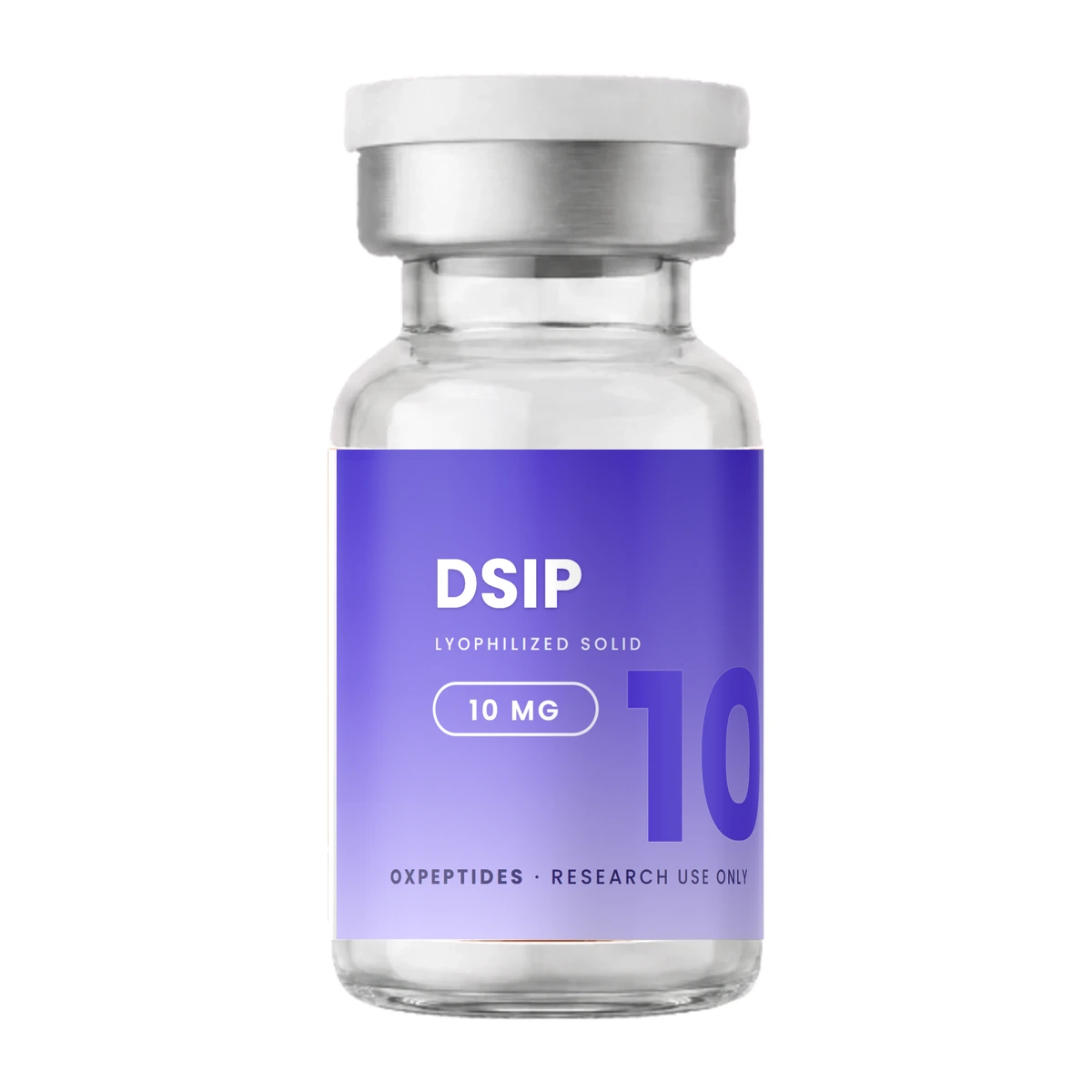
In the catalog
DSIP
from $60
Purity >99% by HPLC — measured value on each lot's COA
| Size | Subscription | One-time | Per mg |
|---|---|---|---|
| 10 mg | $60 | $60 | $6.00/mg |
Research use only. Not for human or veterinary use. Availability is on the product page.
DSIP is a synthetic nonapeptide of sequence Trp-Ala-Gly-Gly-Asp-Ala-Ser-Gly-Glu (one-letter WAGGDASGE), molecular formula C35H48N10O15, monoisotopic mass 848.8 g/mol, CAS 62568-57-4. It is supplied as a white lyophilized powder in a sealed vial, as an acetate salt, with a batch certificate of analysis stating identity and purity. Research use only. Not for human or veterinary use.
What DSIP designates
DSIP is an acronym coined in 1977 for a nine-residue peptide isolated from rabbit cerebral venous blood by Schoenenberger and Monnier.
Everything sold under that name today is made by solid-phase synthesis, not extracted from anything: the sequence is short, it contains no cysteine and therefore no disulfide bridge, and it assembles without difficulty.
Nine residues is small. For comparison, KPV is three, Selank is seven, Semax is seven, and BPC‑157 is fifteen.
A nonapeptide sits at the size where a single chromatographic run resolves the target from its truncated by-products cleanly, which is why purity figures on this compound are usually high and why a low one is a red flag rather than a limitation of the chemistry.
Research use only. Not for human or veterinary use.
Chemical data
| Property | Value |
|---|---|
| Sequence (three-letter) | Trp-Ala-Gly-Gly-Asp-Ala-Ser-Gly-Glu |
| Sequence (one-letter) | WAGGDASGE |
| Residues | 9 |
| Molecular formula | C35H48N10O15 |
| Molecular mass (free peptide) | 848.8 g/mol |
| CAS number | 62568-57-4 |
| Appearance | White to off-white lyophilized powder |
| Supplied as | Acetate salt, sealed borosilicate vial |
| Solubility | Water, and aqueous buffers |
Two residues in the sequence carry the mass.
Tryptophan at position one is the bulkiest of the twenty proteinogenic amino acids and the only one in the chain that shows strongly in the UV at 280 nm, which gives a laboratory a second handle on the compound alongside the 214 nm peptide-bond signal.
Glutamic acid at position nine and aspartic acid at position five make the chain acidic, which is why it dissolves in plain water rather than needing a solvent trick.
The three glycines (positions three, four and eight) are the reason the chain is flexible and the reason a synthesis run produces so few deletion by-products: glycine couples fast.
The acetate salt, and why the powder weighs more than the peptide
A synthetic peptide that carries basic residues is purified by preparative HPLC in a mobile phase containing trifluoroacetic acid, then exchanged onto acetate before freeze-drying.
The vial therefore holds three things: the peptide, its acetate counter-ions, and residual water that the lyophilizer could not pull out.
The practical consequence is one number. A vial filled with 10 mg of powder holds roughly 8 to 9 mg of peptide. That figure is the net peptide content, and a full certificate states it.
It is not a defect, it is what a lyophilized salt is; a laboratory computing a concentration divides by the net figure rather than by the label. The arithmetic is set out on the bacteriostatic water calculator.
A supplier who states the filled mass and never the net content is not lying. The buyer is simply paying for a number nobody has measured.
What a DSIP certificate of analysis states
A batch certificate for a nonapeptide is short, and four lines carry the whole document.
- Purity by reverse-phase HPLC. One main peak, its area against total peak area, detected at 214 nm. On a nine-residue chain a figure above 98 % is ordinary and a figure below 95 % points at a synthesis that went wrong rather than at a hard sequence.
- Mass by mass spectrometry. The measured mass must land near 848.8. A value 57 lower means a glycine is missing; 87 lower means the serine is; a value higher by 42 points at an acetylated by-product. This is where a nonapeptide is either what the label says or not.
- Net peptide content, by amino-acid analysis or nitrogen determination. The field discussed above.
- Lot number, date, laboratory name, and a photograph of the labeled vial. The four fields that tie the document to the object in hand rather than to a production run somewhere.
How to read each field, and how to check a report number against the laboratory itself, is in how to read a Janoshik test report and in how to read a peptide COA. Certificates are published per lot in the COA library.
Size and price: what the catalog offers
DSIP is supplied in one size, a 10 mg vial.
There is no 5 mg or 20 mg format: at this molecular mass and this price per milligram, a smaller vial would cost almost as much to fill, label and certify as the 10 mg one, and a larger one would sit open longer than a laboratory wants.
The catalog card at the top of this page reads the live price and the live stock from the catalog, so it never contradicts the product page.
DSIP is a lower-volume reference: when the card shows it as unavailable, the supply is between lots rather than discontinued, and the notification field on the DSIP product page is the way to hear when a lot lands.
Other short regulatory peptides in the same family are Selank, Semax and Epithalon.
What the price includes at OXpeptides: a sealed, labeled vial from a tested lot, its batch COA, and a replacement if the parcel arrives lost or damaged.
Ships from France (EU) and California (US) · tracked, tracked: $19, free from $150.
Storage of the sealed vial
- Temperature: −20 °C for long-term storage; 2 to 8 °C for periods of a few weeks.
- Light and moisture: keep the vial sealed and in its box. Let a cold vial reach room temperature before it leaves its bag, so no condensation forms on the glass and none of it reaches the powder.
- Shelf life: 24 months for a sealed lyophilized vial stored as above; the date printed on the label governs.
- In solution: refrigerated, protected from light, and split into aliquots at the moment it is made. Freeze-thaw is what destroys a short peptide in solution, not time on the shelf.
Ambient shipping over a few days does not degrade a sealed lyophilized powder, which is why research peptides travel without cold packs. Compound by compound, the rules are in lyophilized peptides: storage and shelf life.
How to check a DSIP listing
A search for this compound returns pharmacies, encyclopaedia entries, journal abstracts and a handful of research suppliers. The listing worth reading answers five questions on the page itself.
- Is the sequence printed? Trp-Ala-Gly-Gly-Asp-Ala-Ser-Gly-Glu, nine residues. A page that names the compound and never writes the sequence has nothing to check.
- Is the mass stated, and is it 848.8? A page giving a different figure is describing a different molecule or copying a different data sheet.
- Is there a batch certificate from a named independent laboratory, with a lot number matching the vial, a date, and a photograph of the labeled vial?
- Is the vial sealed, labeled and lyophilized, with a stated size? A listing that sells a solution has made a choice about storage on your behalf.
- Does the page describe the reagent only (sequence, mass, purity documentation, storage), with research use only stated plainly? A supplier who publishes usage content is a supplier easy to shut down, and the parcel in transit belongs to the buyer.
The seven-point method, including what a re-used or edited certificate looks like, is in how to check a peptide supplier. The US-wide checklist is in where to buy research peptides in the US.
Published research
The publications a researcher will find when looking this compound up, with their DOI. They characterize the molecule and the models it was studied in; they are listed as references, not as claims about this product.
Schoenenberger GA, Monnier M (1977). Proceedings of the National Academy of Sciences, 74(3), 1282-1286.
The paper that isolated the nonapeptide from rabbit cerebral venous blood and gave it the acronym the catalogue still uses.
Graf MV, Kastin AJ (1986). Peptides, 7(6), 1165-1187.
doi:10.1016/0196-9781(86)90148-7
The review that collected the chemistry of the nonapeptide and its analogues a decade after the isolation.
FAQ
What is DSIP?
What is the molecular weight of DSIP?
What sizes does DSIP come in?
What should a DSIP certificate of analysis show?
How is DSIP stored?
Why is DSIP sometimes out of stock?
Related guides
Selank — buying guide
The tuftsin-derived heptapeptide: sequence, mass, 5 and 10 mg vials, what a batch COA must show.
Read Buying guideSemax — buying guide
The ACTH(4-10)-derived heptapeptide: sequence, mass, 5 and 10 mg vials, what a batch COA must show.
Read Quality & storageHow to read a peptide COA
What each field must say, how to verify it on the laboratory site, the signs of an edited certificate.
ReadNext step
DSIP in the OXpeptides catalog
Sizes, price per vial, the batch COA and current availability are on the product page.
See DSIP in the catalogResearch use only. Not for human or veterinary use.