Wolverine peptide: what the BPC‑157 / TB‑500 blend vial actually contains
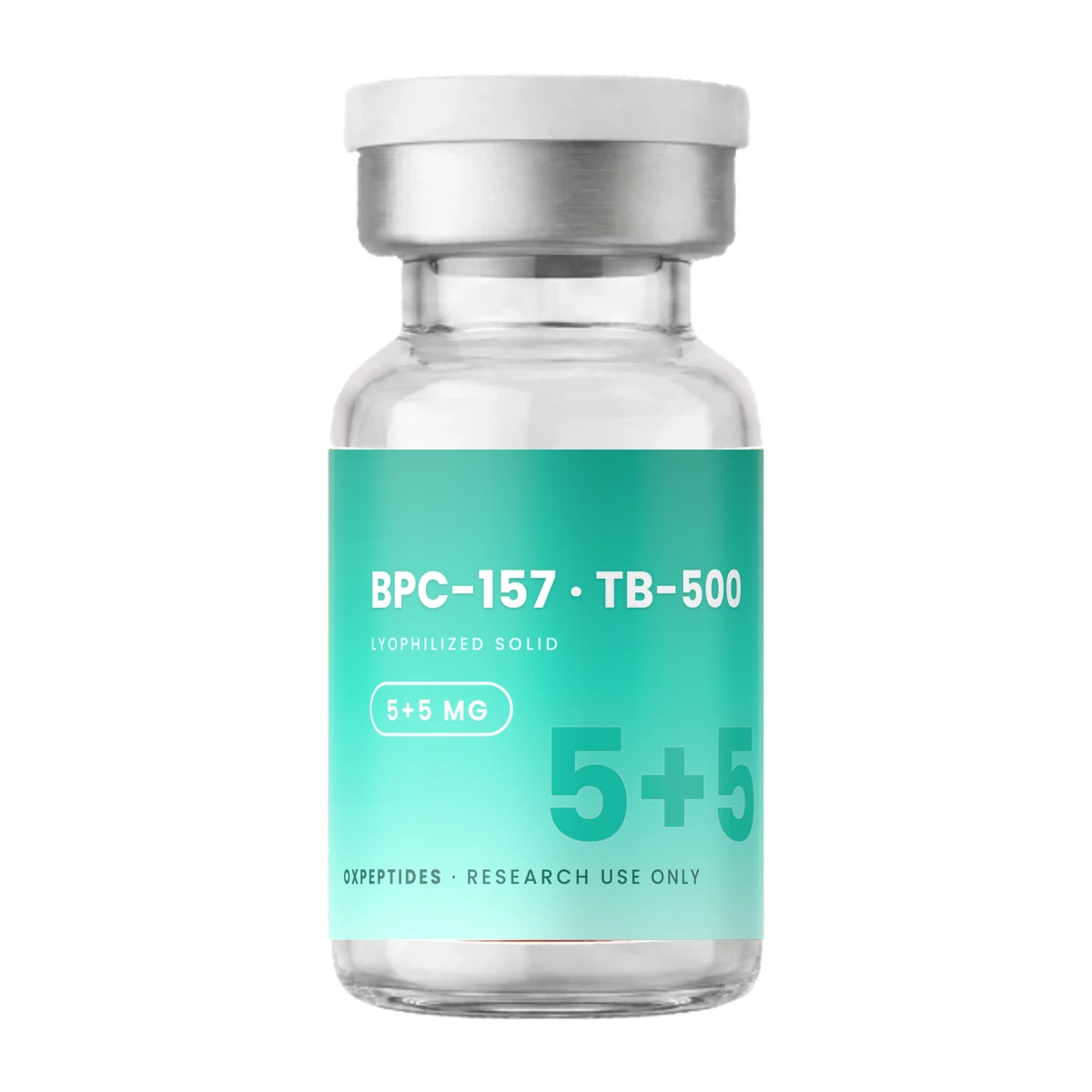
In the catalog
BPC‑157 / TB‑500
from $93.50subscription −15%, or $110 one-time
Purity >99% by HPLC — measured value on each lot's COA
| Size | Subscription | One-time | Per mg |
|---|---|---|---|
| 10 mg | $93.50 | $110 | $9.35/mg |
| 20 mg | $148.75 | $175 | $7.44/mg |
Research use only. Not for human or veterinary use. Availability is on the product page.
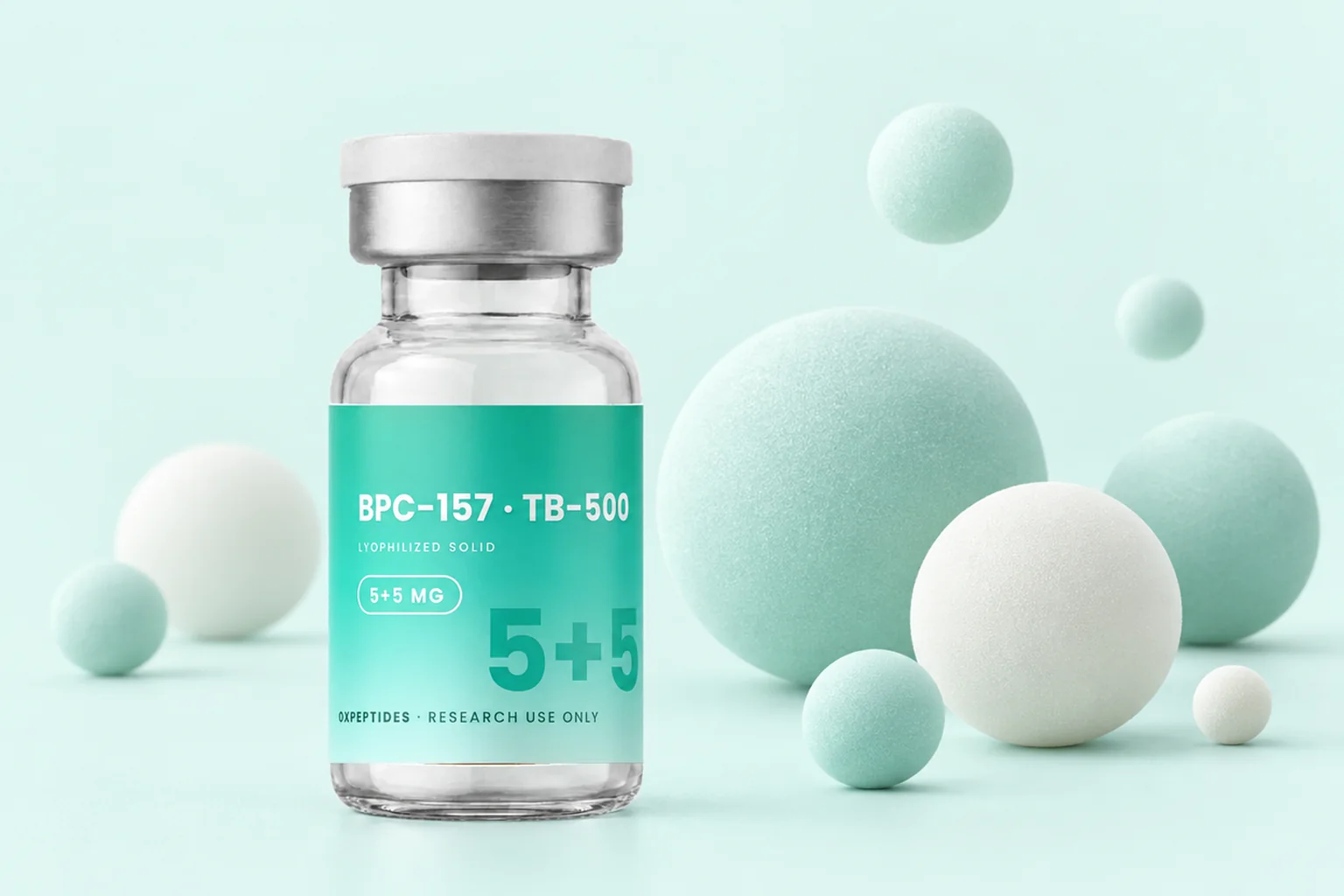
The "Wolverine peptide" is the trade name of the BPC‑157 / TB‑500 blend: one sealed, lyophilized vial holding the 15-residue peptide BPC‑157 and the 7-residue TB‑500 (Ac-LKKTETQ) in equal mass, 5 mg + 5 mg in the 10 mg vial or 10 mg + 10 mg in the 20 mg vial. It is sold as a laboratory reagent with a batch certificate of analysis that reports the purity and mass of each peptide separately. Research use only.
What "Wolverine peptide" means
There is no peptide called Wolverine.
The name is a nickname, borrowed from a comic-book character, that forums and clinics attached to the pairing of two research peptides, BPC‑157 and TB‑500.
Sold as two separate vials, the pairing is called a "stack"; sold as one vial holding both, it is a "blend". The catalog sells the blend under its chemical name, BPC‑157 / TB‑500.
| Component | Sequence | Mass (free peptide) | Sold alone |
|---|---|---|---|
| BPC‑157 | Gly-Glu-Pro-Pro-Pro-Gly-Lys-Pro-Ala-Asp-Asp-Ala-Gly-Leu-Val (15 residues) | 1,419.5 g/mol | BPC‑157, 10 / 20 / 30 mg |
| TB‑500 | Ac-Leu-Lys-Lys-Thr-Glu-Thr-Gln (7 residues, N-acetylated) | 889.0 g/mol | TB‑500, 10 / 20 / 30 mg |
BPC‑157 is a fragment of a protein found in gastric juice, made synthetically since the early 1990s.
TB‑500 is the seven-residue actin-binding segment (residues 17 to 23) of the 43-residue protein thymosin β4; some suppliers sell the full 43-residue protein (4,963 Da) under the same name, and the mass on the certificate tells the two apart.
Both are made by solid-phase synthesis, purified by preparative HPLC and supplied as lyophilized acetate salts. Research use only. Not for human or veterinary use.
What is in the blend vial
The blend is one lyophilized vial holding both peptides in equal mass, weighed separately and freeze-dried together.
| Vial | BPC‑157 | TB‑500 | Total peptide |
|---|---|---|---|
| 10 mg blend | 5 mg | 5 mg | 10 mg |
| 20 mg blend | 10 mg | 10 mg | 20 mg |
Equal mass is not equal molar amount: 5 mg of BPC‑157 (1,419.5 g/mol) is 3.5 micromoles, 5 mg of TB‑500 (889.0 g/mol) is 5.6 micromoles, a molar ratio of about 1 : 1.6.
The certificate reports the two masses; a laboratory that needs the molar ratio derives it from them.
Both peptides are white, so the cake is white and there is no color test as there is for the copper-containing GLOW blend (which adds 50 mg of GHK‑Cu to the same two peptides).
Ten milligrams of peptide is a thin white film at the bottom of a 3 mL vial; a thick layer means a bulking excipient was added, which is acceptable only if the certificate states the net peptide content.
The label reads both names, the total quantity, a lot number and "research use only".
How a two-peptide vial is tested
HPLC: two main peaks, two purity figures
On reverse-phase HPLC the two peptides elute at different retention times, and the chromatogram shows two main peaks.
The laboratory identifies each against its reference standard and reports a purity figure per component, from the area of that peak against its own impurities.
A certificate that prints one "99 %" for the vial has averaged two numbers and hides which peptide is under specification.
Mass spectrometry: two expected masses
TB‑500 appears as the singly charged ion at m/z 889.5 [M+H]+; BPC‑157 as m/z 1,419.7 [M+H]+ or 710.4 [M+2H]2+ (monoisotopic values).
Both must be present. A mass around 4,963 means the full thymosin β4 protein was used instead of the seven-residue fragment; a missing mass means a missing component.
What else must be on the page
- The laboratory's name and a verifiable test number (Janoshik Analytical is the reference in this market).
- The lot number, identical to the one printed on the vial.
- The test date and a photograph of the tested vial wearing the supplier's label. A certificate for a bare manufacturer's vial says nothing about the finished product.
The OXpeptides certificates are published per lot in the COA library and on the blend product page as each lot returns from the laboratory. The field-by-field reading is in how to read a peptide COA.
Blend or two vials: what the catalog offers
The pair can be bought two ways.
- The blend, 10 mg (5 + 5) or 20 mg (10 + 10): one vial, one fill, one label, one laboratory test covering both peptides. This is the lower price for the same mass.
- BPC‑157 and TB‑500 as separate vials, 10, 20 or 30 mg each: two lots, two certificates, and the freedom to hold the two peptides in any proportion. This is what a laboratory chooses when the fixed 1 : 1 mass ratio of the blend is not the ratio it needs.
The catalog card at the top of this page reads the live prices.
Volume tiers apply from two vials of the same size; the subscription price applies to every delivery. The two peptides side by side, with what each certificate shows, are described in BPC‑157 and TB‑500: two research peptides.
What the price includes at OXpeptides: a sealed, labeled vial from a tested lot, its batch COA, and a replacement if the parcel arrives lost or damaged.
Ships from France (EU) and California (US) · tracked, tracked: $19, free from $150.
Storage of the sealed vial
- Temperature: −20 °C for long-term storage; a refrigerator (2 to 8 °C) for a few weeks.
- Light and moisture: keep the vial sealed and in its box; let a cold vial reach room temperature before it leaves its bag so no condensation forms on the glass.
- Stability: neither sequence contains methionine, cysteine or tryptophan, the three residues most exposed to oxidation, so this blend is among the least demanding on the shelf. BPC‑157 in particular keeps its structure in solution for days, which is what the "stable" in its published name refers to.
- Shelf life: 24 months for a sealed lyophilized vial stored cold; the date on the label governs.
A few days of ambient shipping do not degrade the sealed powder. The rules compound by compound are in lyophilized peptides: storage and shelf life.
How to check a "Wolverine" listing
A search for "Wolverine peptide" returns clinics and general-audience sites first, research suppliers second. For a laboratory that needs the reagent, the listing that matters answers five questions on the page itself.
- Are the two masses stated? "Wolverine 10 mg" without the breakdown (5 + 5) is a nickname, not a composition.
- Which TB‑500? The seven-residue fragment (889 Da) or the full protein (4,963 Da). The certificate's mass answers it.
- Is there a batch COA with two peaks and two masses, from a named independent laboratory, verifiable on the lab's site, showing the supplier's labeled vial with the lot number you receive?
- Does the vial ship from domestic stock, tracked, in a few days? The catalog ships from California to the US and from France to Europe.
- Does the page describe the reagent only (composition, purity documentation, storage), with "research use only" stated plainly? A supplier that publishes usage content is a supplier that is easy to shut down, and that risk lands on the buyer whose parcel is in transit.
The seven-point method, with what a re-used or edited certificate looks like, is in how to check a peptide supplier; the US-wide checklist in where to buy research peptides in the US.
Published research
The publications a researcher will find when looking this compound up, with their DOI. They characterize the molecule and the models it was studied in; they are listed as references, not as claims about this product.
Sikiric P, et al. (2011). Current Pharmaceutical Design, 17(16), 1612-1632.
doi:10.2174/138161211796196954
The Zagreb group's review of the 15-residue peptide: its origin as a fragment of a gastric protein, its stability and analytical characterization.
Goldstein AL, Hannappel E, Kleinman HK (2005). Trends in Molecular Medicine.
doi:10.1016/j.molmed.2005.07.004
The review of thymosin β4 that locates the actin-binding segment LKKTETQ, the seven residues sold as TB-500.
FAQ
What is the Wolverine peptide?
What is in a Wolverine blend 10 mg vial?
Wolverine stack vs Wolverine blend: what is the difference?
How is the blend vial tested?
Which TB‑500 is in the blend?
How is the blend stored?
Related guides
BPC‑157 vs TB‑500 as reagents
Two peptides compared as objects: sequence, mass, vial sizes, and what each certificate has to show.
Read Buying guideTB‑500 peptide: technical data sheet
Ac-LKKTETQ, 889.0 g/mol, CAS 885340-08-9: the numbers, the two objects sold under the name, the COA.
Read Buying guideGLOW blend: components, COA, 70 mg vial
BPC‑157, GHK‑Cu and TB‑500 in one lyophilized vial: the masses, the three-peak chromatogram, storage.
ReadNext step
BPC‑157 / TB‑500 in the OXpeptides catalog
Sizes, price per vial, the batch COA and current availability are on the product page.
See BPC‑157 / TB‑500 in the catalogResearch use only. Not for human or veterinary use.