TB‑500 peptide: technical data sheet (sequence, mass, CAS, form, COA, sizes)
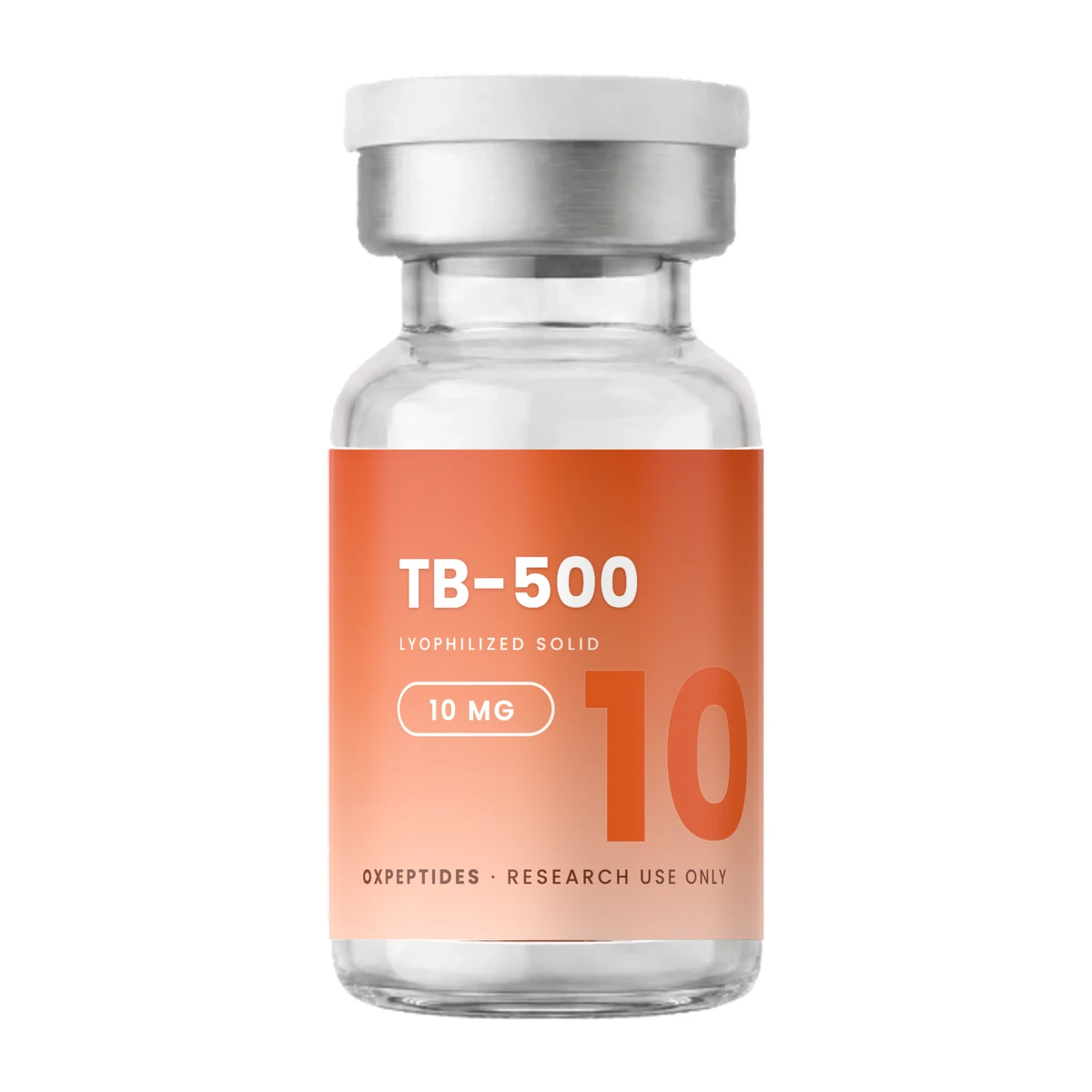
In the catalog
TB‑500
from $75.65subscription −15%, or $89 one-time
Purity >99% by HPLC — measured value on each lot's COA
| Size | Subscription | One-time | Per mg |
|---|---|---|---|
| 10 mg | $75.65 | $89 | $7.57/mg |
| 20 mg | $120.70 | $142 | $6.04/mg |
| 30 mg | $172.55 | $203 | $5.75/mg |
Research use only. Not for human or veterinary use. Availability is on the product page.
TB‑500 is a synthetic peptide derived from thymosin β4. The reagent listed in the OXpeptides catalog is the N-acetylated heptapeptide Ac-Leu-Lys-Lys-Thr-Glu-Thr-Gln (Ac-LKKTETQ, residues 17 to 23 of thymosin β4), formula C38H68N10O14, 889.0 g/mol, CAS 885340-08-9, supplied as a lyophilized acetate salt in sealed 10, 20 and 30 mg vials with a batch certificate of analysis (HPLC purity and mass confirmation). Some vendors sell full-length thymosin β4 (43 residues, about 4,963 Da) under the same name; the mass on the certificate tells the two apart.
Identity: what "TB‑500" designates
"TB‑500" is a trade name.
It designates a synthetic peptide made from the sequence of thymosin β4 (Tβ4), a 43-residue protein present in the cytosol of most cell types, where it binds monomeric actin.
The name does not specify which part of Tβ4 was synthesized, and two different objects circulate under it.
| Ac-LKKTETQ (the catalog's TB‑500) | Full-length thymosin β4 | |
|---|---|---|
| Residues | 7 (Tβ4 positions 17 to 23), N-acetylated | 43, N-acetylated (Ac-SDKP…) |
| Formula | C38H68N10O14 | C212H350N56O78S |
| Average mass | 889.0 g/mol | about 4,963 g/mol |
| CAS | 885340-08-9 | 77591-33-4 |
| What the mass spectrum shows | Ions near 889 (M+H+ at 890.0) | Multiply charged ions deconvoluting to about 4,963 |
The heptapeptide Ac-LKKTETQ is the segment of Tβ4 that binds actin, identified in the cell-free work of the early 1990s.
It is the object described on the TB‑500 product page and in this sheet. The mass on the certificate of analysis is what tells a buyer which of the two objects went into a given vial. Research use only.
Not for human or veterinary use.
Listings spell the name several ways: TB‑500, TB500, "TB‑500 acetate", "Tβ4 (17-23)", "thymosin beta-4 fragment".
The spelling carries no information; the sequence, the mass and the CAS number do. A listing that gives none of the three has not said what it sells, whatever it calls it.
Chemical data
The numbers below are those of the catalog entry, with the CAS number checked against the PubChem record.
| Field | Value |
|---|---|
| Sequence (one-letter) | Ac-LKKTETQ |
| Sequence (three-letter) | Ac-Leu-Lys-Lys-Thr-Glu-Thr-Gln-OH |
| Parent protein | Thymosin β4, residues 17 to 23 |
| N-terminus | Acetylated |
| C-terminus | Free acid |
| Molecular formula (free peptide) | C38H68N10O14 |
| Average molecular weight | 889.0 g/mol |
| Monoisotopic mass | 888.49 Da |
| CAS registry number | 885340-08-9 |
| Salt form as supplied | Acetate |
| Appearance | White to off-white lyophilized powder |
| Solubility | Freely soluble in water; two lysines and a glutamate make it strongly hydrophilic |
| Net charge at neutral pH | About 0 (two Lys, one Glu, one C-terminal carboxylate; the N-terminus is acetylated) |
Seven residues is short. On a reverse-phase column the heptapeptide and the 15-residue BPC‑157 elute at different retention times, which is how the two are told apart on the single chromatogram of the BPC‑157 + TB‑500 vial.
The acetate salt and the lyophilized form
A synthetic peptide leaves preparative HPLC in a solution that contains trifluoroacetic acid from the mobile phase.
Reputable manufacturers exchange that counter-ion for acetate before freeze-drying, so what arrives in the vial is the acetate salt of Ac-LKKTETQ plus a few percent of bound water.
Two consequences follow for anyone reading a label:
- Purity and peptide content are two numbers. HPLC purity (the share of peptide among peptide-like material) can read 99 % while peptide content (the share of the powder's mass that is peptide rather than acetate and water) reads 85 to 90 %. Both are legitimate. A certificate reports the first; a good one also reports the second. The difference is explained in HPLC purity: what 99 % means.
- Ten milligrams is a thin cake. In a 3 mL vial, 10 mg of a freeze-dried heptapeptide sits as a white film at the bottom, sometimes barely visible against the glass. That is the normal appearance of the fill, not a short vial.
Lyophilization removes the water by sublimation from the frozen solution, which leaves the peptide as a porous solid that dissolves in seconds and, sealed and cold, keeps for two years.
The process and its limits are described in lyophilized peptides: storage and shelf life.
What the batch certificate of analysis measures
For a peptide sold under a trade name, the certificate does two jobs. It says which object is in the vial (identity) and how clean it is (purity). A complete TB‑500 certificate carries:
- Mass spectrometry. An observed mass consistent with 889.0 g/mol (M+H+ near 890) for Ac-LKKTETQ. A spectrum that deconvolutes to about 4,963 is full-length Tβ4; a different number is a different compound.
- HPLC purity, as a measured percentage with the chromatogram: one dominant peak, and the small peaks that always accompany a synthetic peptide (deletion sequences, a de-acetylated fraction, oxidized variants). Text that says "≥ 98 %" without a trace is a claim, not a measurement.
- The laboratory's name and a verifiable test number. Janoshik Analytical is the reference laboratory of this market; its reports can be looked up on its site.
- The lot number printed on the vial, the test date, and a photograph of the tested vial wearing the supplier's own label.
OXpeptides publishes the certificate of each TB‑500 lot in the COA library and on the product page. A certificate is read field by field in how to read a peptide COA.
Sizes and formats in the catalog
TB‑500 is supplied as a lyophilized powder in a sealed 3 mL borosilicate vial with a bromobutyl septum and an aluminum crimp cap, in three fills:
| Format | Content | Label |
|---|---|---|
| TB‑500 10 mg | 10 mg Ac-LKKTETQ, acetate | Name, net mg, lot, "research use only" |
| TB‑500 20 mg | 20 mg, same vial | Same |
| TB‑500 30 mg | 30 mg, same vial | Same |
| BPC‑157 + TB‑500 | 5 + 5 mg or 10 + 10 mg in one vial | Both names, both masses |
| GLOW | 10 mg TB‑500 with 10 mg BPC‑157 and 50 mg GHK‑Cu (70 mg) | Three names, three masses |
The catalog card at the top of this page reads the live price of each single-peptide size.
A 3 mL vial of bacteriostatic water, the laboratory solvent for lyophilized peptides, is listed alongside. Prices, the supplier checklist and the "buy" side of the question are in the TB‑500 buying guide.
Storage
- Sealed vial: −20 °C, protected from light and moisture; 2 to 8 °C is acceptable for up to four weeks. Shelf life 24 months from the fill date.
- Condensation: let a cold vial reach room temperature before it leaves its bag, so water condenses on the bag and not on the septum.
- Shipping: a few days at ambient temperature do not degrade the sealed powder, which is why the vial ships without a cold pack.
The heptapeptide has no cysteine and no methionine, the two residues most prone to oxidation, and no aspartate-glycine pair prone to rearrangement, which makes it one of the more stable short peptides in the catalog as a dry solid.
Repeated warming and cooling of a sealed vial does no measurable harm to that solid. The risk is water.
A septum pierced while the glass is still cold pulls in condensation, and a wet cake degrades in weeks where a dry one keeps for two years.
TB‑500 in the literature: what the name points to
Search the trade name in a scientific database and nothing comes back. The literature is written about thymosin β4, the protein, and about its actin-binding segment.
Two papers anchor the chemistry. Safer, Elzinga and Nachmias (1991) showed in a cell-free system that thymosin β4 is the actin-sequestering peptide of the cytosol.
Goldstein and Kleinman (2005) reviewed the protein and located the actin-binding segment at residues 17 to 23, the LKKTETQ sequence the catalog's TB‑500 reproduces. Both are listed below with their DOI.
What a buyer takes from that: a listing that gives a sequence, a formula, a mass and a CAS number describes an object that can be checked against the literature and against a mass spectrum.
A listing that gives only the trade name describes nothing.
Published research
The publications a researcher will find when looking this compound up, with their DOI. They characterize the molecule and the models it was studied in; they are listed as references, not as claims about this product.
Goldstein AL, Kleinman HK (2005). Trends in Molecular Medicine, 11(9), 421-429.
doi:10.1016/j.molmed.2005.07.004
The reference review on thymosin β4, the 43-residue protein from which TB-500 is derived: its sequence, and the segment (residues 17 to 23) that binds actin.
Safer D, Elzinga M, Nachmias VT (1991). Journal of Biological Chemistry, 266(7), 4029-4032.
doi:10.1016/S0021-9258(20)64278-8
The paper that established thymosin β4 as the actin-binding peptide of the cytosol, in a cell-free biochemical system.
FAQ
What is the sequence of TB‑500?
What is the molecular weight of TB‑500?
What is the CAS number of TB‑500?
How do I know which TB‑500 is in a vial?
What sizes does TB‑500 come in?
How is TB‑500 stored?
Related guides
TB‑500 — buying guide
What the trade name covers, the white powder, vial sizes, what a batch COA must show, storage.
Read Buying guideBPC‑157 vs TB‑500 as reagents
Two peptides compared as objects: sequence, mass, vial sizes, and what each certificate has to show.
Read Quality & storagePurity: what "99 %" HPLC means
What the HPLC measures, why 99 % is not 99 mg in a 100 mg vial, why a percentage needs a chromatogram.
ReadNext step
TB‑500 in the OXpeptides catalog
Sizes, price per vial, the batch COA and current availability are on the product page.
See TB‑500 in the catalogResearch use only. Not for human or veterinary use.