CJC-1295 DAC, Mod GRF 1-29 and the CJC-1295 / Ipamorelin blend: what is in each vial
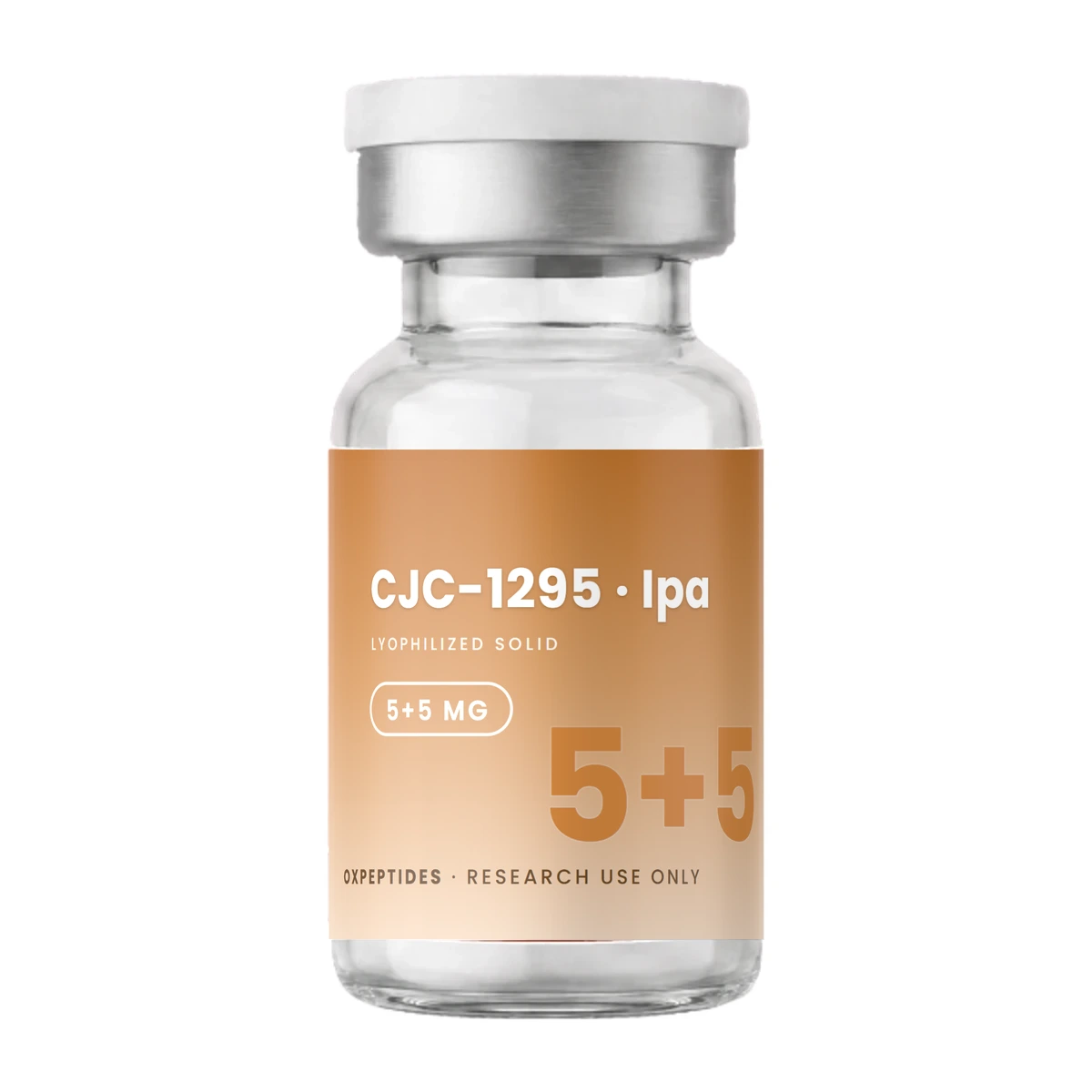
In the catalog
CJC-1295 / Ipamorelin
from $80.75subscription −15%, or $95 one-time
Purity >99% by HPLC — measured value on each lot's COA
| Size | Subscription | One-time | Per mg |
|---|---|---|---|
| 10 mg | $80.75 | $95 | $8.07/mg |
Research use only. Not for human or veterinary use. Availability is on the product page.
CJC-1295 DAC is a 30-residue GHRH analogue with an albumin-binding linker (3,647.3 g/mol); "CJC-1295 no DAC" is Mod GRF 1-29, the same 29-residue analogue without the linker (3,367.9 g/mol); Ipamorelin is a pentapeptide (711.9 g/mol). The CJC-1295 / Ipamorelin blend is one lyophilized vial holding Mod GRF 1-29 and Ipamorelin in equal mass, 5 mg + 5 mg in the 10 mg vial. Research use only.
Three molecules behind two names
The name "CJC-1295" covers two different peptides, and "CJC-1295 / Ipamorelin" adds a third. The certificate of analysis tells them apart by mass; the label alone does not.
| CJC-1295 DAC | Mod GRF 1-29 ("CJC-1295 no DAC") | Ipamorelin | |
|---|---|---|---|
| Family | GHRH analogue | GHRH analogue | growth hormone secretagogue (pentapeptide) |
| Length | 30 residues | 29 residues | 5 residues |
| Sequence | Mod GRF 1-29 + Lys30(maleimidopropionyl) | GHRH 1-29 with D-Ala2, Gln8, Ala15, Leu27 | Aib-His-D-2-Nal-D-Phe-Lys-NH2 |
| Mass | 3,647.3 g/mol | 3,367.9 g/mol | 711.9 g/mol |
| What the modification is for | the linker ("DAC", an albumin-binding tag) binds serum albumin, keeping the peptide in circulation for days | the four substitutions block the enzymatic cleavage sites of the native sequence | the two D-amino acids and the Aib residue protect the short chain from cleavage |
| Catalog | CJC-1295 DAC, 5 mg | in the blend | Ipamorelin, 5 mg |
The unmodified parent sequence, GHRH 1-29 itself, is sold as sermorelin and has its own guide: sermorelin peptide: sequence, COA, sizes.
All three are made by solid-phase synthesis, purified by preparative HPLC and supplied as lyophilized acetate salts. Research use only. Not for human or veterinary use.
DAC or no DAC: reading the mass
The DAC is a small chemical tag, a maleimidopropionic acid attached to a lysine added at position 30.
It adds 279.4 daltons to the 29-residue analogue, which is the whole difference between 3,367.9 and 3,647.3 g/mol.
On a certificate the two are impossible to confuse: a mass spectrum that deconvolutes to 3,647 is CJC-1295 DAC; one that deconvolutes to 3,368 is Mod GRF 1-29, whatever the label says.
Two further details identify the DAC version on a report. First, its HPLC retention time is longer, because the linker is hydrophobic.
Second, the maleimide group is reactive toward thiols; a laboratory that stores the reference standard in a thiol-containing buffer will see an adduct peak.
Neither is a defect of the reagent, but both are reasons the DAC and no-DAC versions cannot be certified against the same standard.
The catalog keeps the two apart on purpose: CJC-1295 DAC is sold alone in a 5 mg vial, and the no-DAC sequence is sold only inside the blend, where the certificate reports it under its own name, Mod GRF 1-29.
What is in the CJC-1295 / Ipamorelin blend vial
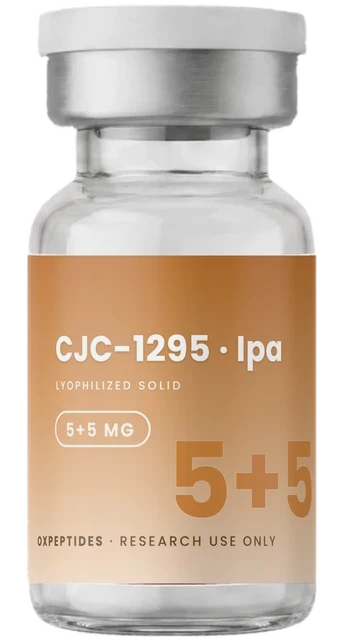
The blend is one lyophilized vial holding both peptides in equal mass, weighed separately and freeze-dried together.
| Vial | Mod GRF 1-29 | Ipamorelin | Total peptide |
|---|---|---|---|
| 10 mg blend | 5 mg | 5 mg | 10 mg |
Equal mass does not mean equal molar amount.
Mod GRF 1-29 is 3,368 g/mol and Ipamorelin 712 g/mol, so 5 mg of each is 1.5 micromoles of the GHRH analogue against 7.0 micromoles of the pentapeptide, a molar ratio of about 1 : 4.7.
A certificate reports the two masses, and a buyer who needs the molar ratio derives it from them.
Both components are white powders, so the cake is white; there is no color test as there is for a copper-peptide blend. The label states both names, the total quantity, a lot number and "research use only".
The blend uses the no-DAC analogue because a linker designed to hold a peptide in circulation for days makes no sense next to a pentapeptide that is cleared in minutes; a "CJC-1295 DAC / Ipamorelin" blend is a listing to question.
How a two-peptide vial is tested
HPLC: two main peaks, two purity figures
On reverse-phase HPLC the pentapeptide elutes early and the 29-residue analogue late; the chromatogram shows two well-separated main peaks.
The laboratory identifies each against its reference standard and reports a purity figure per component, from the area of that component's peak against its own impurities.
A certificate that prints one "99 %" for the vial has averaged two numbers into one and hides which component is under specification.
Mass spectrometry: two expected masses
Ipamorelin is seen as the singly charged ion at m/z 712.4 [M+H]+ (monoisotopic), and Mod GRF 1-29 as multiply charged ions (about 1,123.6 for [M+3H]3+, 843.0 for [M+4H]4+) reconstructing to 3,367.9.
Both masses must be present. A reconstructed mass of 3,647 in a "no DAC" blend means the DAC version was used.
What else must be on the page
- The laboratory's name and a verifiable test number (Janoshik Analytical is the reference in this market).
- The lot number, identical to the one on the vial.
- The test date and a photograph of the tested vial wearing the supplier's label.
The OXpeptides certificates are published per lot in the COA library and on the blend product page. The full reading method is in how to read a peptide COA; a four-peptide example is in the KLOW guide.
Sizes and price: what the catalog offers
Three listings cover the three molecules:
- CJC-1295 / Ipamorelin blend: 10 mg (5 + 5). One laboratory test covers both components.
- CJC-1295 DAC: 5 mg, alone.
- Ipamorelin: 5 mg, alone, for a laboratory that prefers to hold each compound in its own lot.
The catalog card at the top of this page reads the live prices.
Bought as two separate vials, 5 mg of each peptide costs more than the 10 mg blend, because two vials mean two fills, two labels and two certificates.
Volume tiers apply from two vials of the same size; the subscription price applies to every delivery.
What the price includes at OXpeptides: a sealed, labeled vial from a tested lot, its batch COA, and a replacement if the parcel arrives lost or damaged.
Ships from France (EU) and California (US) · tracked, tracked: $19, free from $150.
Storage of the sealed vials
- Temperature: −20 °C for long-term storage; a refrigerator (2 to 8 °C) for a few weeks.
- Light, moisture, oxygen: keep the vial sealed and in its box; let a cold vial reach room temperature before it leaves its bag.
- The DAC linker: the maleimide group is the one part of these three molecules that reacts with something other than water. Keep the CJC-1295 DAC vial sealed and away from any thiol-containing reagent until it is used.
- Shelf life: 24 months for a sealed lyophilized vial stored cold; the date on the label governs.
A few days of ambient shipping do not degrade the sealed powder. The rules compound by compound are in lyophilized peptides: storage and shelf life.
How to check a CJC-1295 or Ipamorelin listing
- Which CJC-1295? The page must say DAC or Mod GRF 1-29, and the certificate must show 3,647 or 3,368.
- For a blend, are both masses stated (5 + 5) and does the COA carry two peaks and two masses?
- Is the COA from a named independent laboratory, verifiable on the lab's site, showing the supplier's labeled vial with the lot number you receive?
- Does the vial ship from domestic stock, tracked, in a few days? The catalog ships from California to the US and from France to Europe.
- Does the page describe the reagent only, with "research use only" stated plainly?
The seven-point method is in how to check a peptide supplier; the US-wide checklist in where to buy research peptides in the US.
Published research
The publications a researcher will find when looking this compound up, with their DOI. They characterize the molecule and the models it was studied in; they are listed as references, not as claims about this product.
Teichman SL, Neale A, Lawrence B, Gagnon C, Castaigne JP, Frohman LG (2006). Journal of Clinical Endocrinology & Metabolism.
The publication that characterizes CJC-1295 with its DAC linker: sequence, the four substitutions, albumin binding.
Raun K, Hansen BS, Johansen NL, Thøgersen H, Madsen K, Ankersen M, Andersen PH (1998). European Journal of Endocrinology.
The original description of the pentapeptide by the Novo Nordisk group: sequence, mass, receptor selectivity in vitro.
FAQ
What is the difference between CJC-1295 DAC and CJC-1295 no DAC?
What is in a CJC-1295 / Ipamorelin 10 mg blend vial?
What is Ipamorelin?
How is a blend vial tested?
Why does the blend use the no-DAC version?
How are these vials stored?
Related guides
Sermorelin: sequence, COA, sizes
The 29-residue GHRH fragment as a reagent: what is in the vial, how it differs from CJC-1295, the COA.
Read Buying guideKLOW blend: inside, testing, sizes
Four peptides in one 80 mg vial: the exact masses, how a blend COA reads, and how KLOW differs from GLOW.
Read Quality & storageHow to read a peptide COA
What each field must say, how to verify it on the laboratory site, the signs of an edited certificate.
ReadNext step
CJC-1295 / Ipamorelin in the OXpeptides catalog
Sizes, price per vial, the batch COA and current availability are on the product page.
See CJC-1295 / Ipamorelin in the catalogResearch use only. Not for human or veterinary use.