KLOW peptide blend: what is inside, how it is tested, sizes
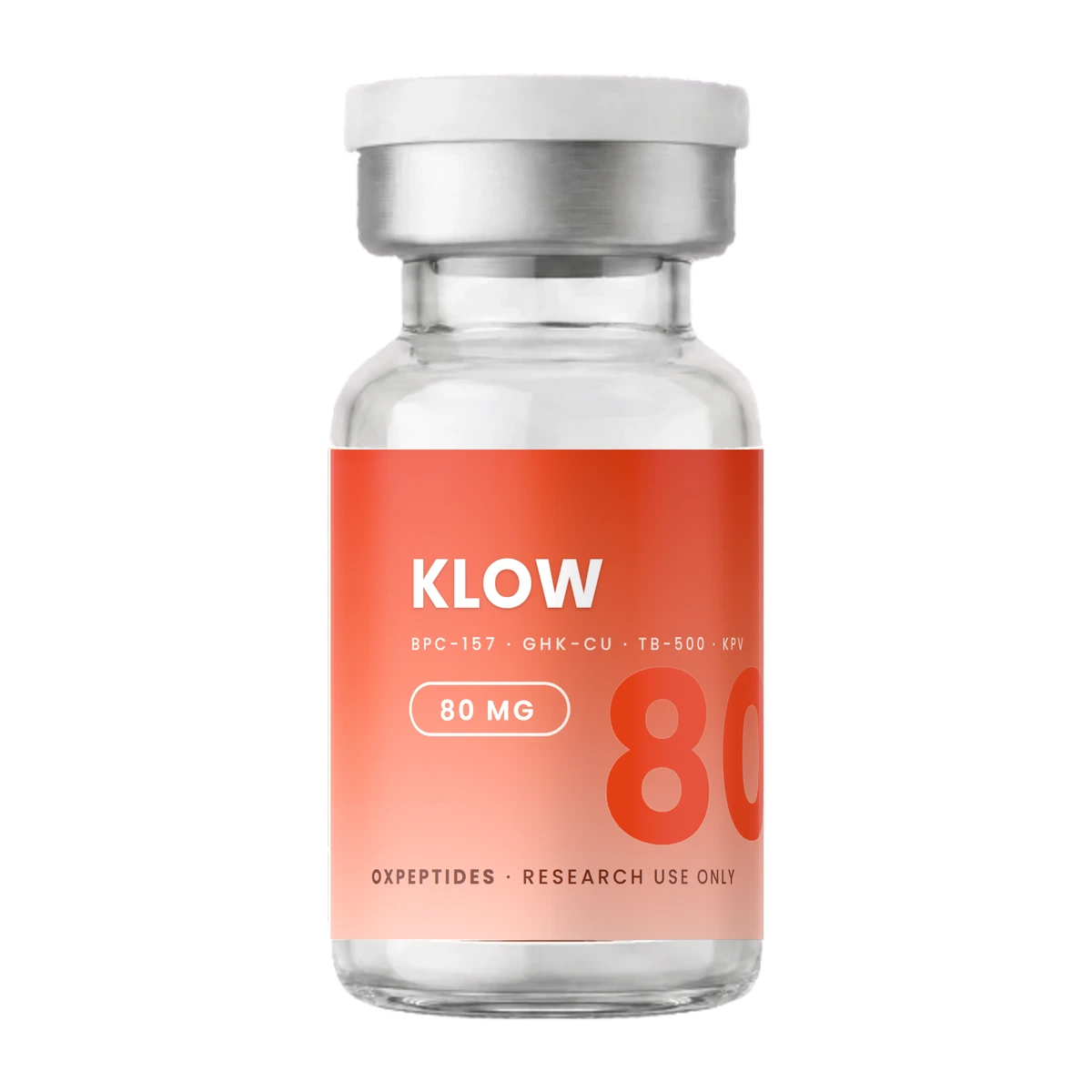
In the catalog
KLOW
from $134.30subscription −15%, or $158 one-time
Purity >99% by HPLC — measured value on each lot's COA
| Size | Subscription | One-time | Per mg |
|---|---|---|---|
| 80 mg | $134.30 | $158 | $1.68/mg |
Research use only. Not for human or veterinary use. Availability is on the product page.
KLOW is a research blend of four peptides supplied in one sealed, lyophilized 80 mg vial: 10 mg BPC‑157, 50 mg GHK‑Cu (copper tripeptide), 10 mg TB‑500 and 10 mg KPV (Lys-Pro-Val). The name is the GLOW blend with a K for KPV. It is bought as a laboratory reagent with a batch certificate of analysis that reports the identity and purity of each of the four peptides separately.
What KLOW is
KLOW is a trade name for the three-peptide GLOW blend with a K in front, for the tripeptide KPV that was added to it.
Behind the name, the object is simple. Four synthetic peptides, weighed separately, filled into one vial and freeze-dried together.
The four components are all sold on their own in the catalog, each with its own sequence and mass:
| Component | Sequence | Mass (free peptide) | In one KLOW vial |
|---|---|---|---|
| BPC‑157 | GEPPPGKPADDAGLV (15 residues) | 1,419.5 g/mol | 10 mg |
| GHK‑Cu | Gly-His-Lys · Cu(II) | 340.4 g/mol (GHK), 403.9 g/mol (complex) | 50 mg |
| TB‑500 | Ac-LKKTETQ (7 residues) | 889.0 g/mol | 10 mg |
| KPV | Lys-Pro-Val (3 residues) | 342.4 g/mol | 10 mg |
Total: 80 mg of peptide in a single sealed glass vial. KLOW is the four-component version of GLOW, which holds the first three only (70 mg). Research use only. Not for human or veterinary use.
What is inside the 80 mg vial
Open the box and you find one 3 mL borosilicate vial with a bromobutyl septum and an aluminum crimp cap. At the bottom sits a lyophilized cake. Two things about that cake tell you what it is before any instrument does.
The color. GHK‑Cu is a copper(II) complex, and copper(II) is blue-violet.
Fifty of the eighty milligrams are GHK‑Cu, so a KLOW cake is visibly blue-violet, the same tint as a plain GHK‑Cu vial, slightly paler because the other three peptides are white.
A white "KLOW" cake means the copper tripeptide was left out, or never weighed in.
The volume. Eighty milligrams of freeze-dried peptide is far more material than the 10 mg most single-peptide vials carry.
The cake fills a visible layer at the bottom of the vial rather than a film. A KLOW vial that looks empty has not received its 80 mg.
The proportions are not equal. GHK‑Cu, a three-residue peptide in industrial production for decades, is the least costly of the four per milligram, and the blend carries five times more of it.
BPC‑157 (15 residues) and TB‑500 (a seven-residue acetylated fragment of thymosin β4) are costlier per milligram and are present at 10 mg each, the same quantity as their single vials. KPV, a tripeptide like GHK, is at 10 mg.
Every component is a synthetic peptide, made by solid-phase synthesis, purified by preparative HPLC and isolated as an acetate salt.
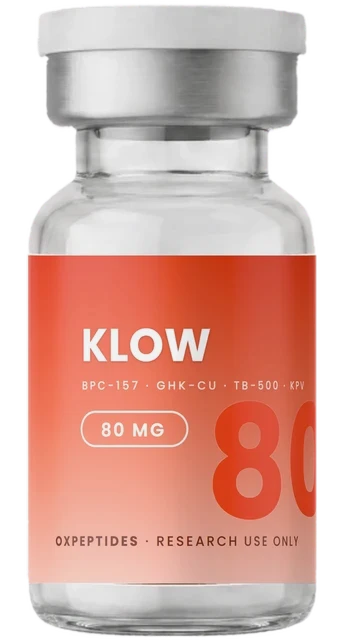
The label on the vial states the four names, the total quantity (80 mg), a lot number and "research use only".
How a four-peptide vial is tested: reading the KLOW certificate of analysis
A blend raises a question a single-peptide vial does not. How does a laboratory confirm that all four peptides are present, in the stated proportions, at the stated purity? The answer is on the certificate, and it has two parts.
HPLC: one main peak per component
On a reverse-phase HPLC run, each peptide elutes at its own retention time. A KLOW chromatogram therefore shows four main peaks, not one.
The laboratory identifies each peak by running the four reference standards under the same gradient, then reports a purity figure per component, calculated from the area of that component's peak against its own impurities.
A certificate that prints a single "99 %" for the whole vial has averaged four numbers into one, and hides which component is under specification.
Mass spectrometry: four expected masses
The mass spectrum of the dissolved sample must show ions at each expected mass: about 1,419.5 for BPC‑157, 340.4 for GHK (the copper dissociates under the usual ionization), 889.0 for TB‑500 and 342.4 for KPV.
A missing mass is a missing component. Because GHK and KPV are close in mass (340.4 and 342.4), the report has to resolve the two, which a modern instrument does without difficulty.
What else must be on the page
- The laboratory's name and a verifiable test number. In this market the reference is Janoshik Analytical, whose reports can be looked up on the lab's own site.
- The lot number, identical to the one printed on the vial.
- The test date and a photograph of the tested vial wearing the supplier's label. A certificate for a bare vial was issued to a manufacturer, and says nothing about the finished product.
The OXpeptides certificates are published per lot in the COA library, and on the KLOW product page as soon as a lot comes back from the laboratory. The full field-by-field reading is in how to read a peptide COA.
KLOW vs GLOW: one component apart
The two blends share three components at identical masses. KLOW adds 10 mg of KPV.
| GLOW | KLOW | |
|---|---|---|
| BPC‑157 | 10 mg | 10 mg |
| GHK‑Cu | 50 mg | 50 mg |
| TB‑500 | 10 mg | 10 mg |
| KPV | none | 10 mg |
| Total per vial | 70 mg | 80 mg |
| Peaks on the HPLC trace | 3 | 4 |
| Ships to | United States | United States, Canada, UK, Australia, Europe |
On a bench the two vials look alike: the same blue-violet cake, the same 3 mL glass.
Only the label and the certificate tell them apart, which is one more reason to check that the lot number on the vial matches the lot on the COA. The three-component blend has its own guide: GLOW peptide blend.
The tripeptide that makes the difference is described in KPV peptide: what it is, how it is supplied, and sold alone on the KPV product page.
Sizes and price: what the catalog offers
KLOW comes in one size, 80 mg. There is no 40 mg or 160 mg vial, because the blend is defined by its four fixed masses; a different total would be a different product.
The single-peptide components are available separately in their usual sizes (BPC‑157 and TB‑500 in 10, 20 and 30 mg; GHK‑Cu in 100, 200 and 300 mg; KPV in 10 mg) for a laboratory that prefers to hold each compound in its own lot.
The catalog card at the top of this page reads the live price from the catalog.
Bought as four separate vials at their smallest sizes, the same 80 mg of peptide costs more than the blend, because four vials mean four fills, four labels and four certificates.
The blend pays for one laboratory test that covers all four components.
What the price includes at OXpeptides: a sealed, labeled vial from a tested lot, its batch COA, and a replacement if the parcel arrives lost or damaged.
Ships from France (EU) and California (US) · tracked, tracked: $19, free from $150.
Storage of the sealed vial
A blend is stored like its most demanding component. Of the four, GHK‑Cu is the one that also asks to be kept away from oxygen (the copper complex), so the KLOW storage line follows the GHK‑Cu line:
- Temperature: −20 °C for long-term storage; a refrigerator (2 to 8 °C) for short periods of a few weeks.
- Light, moisture, oxygen: keep the vial sealed and in its box. Let a cold vial reach room temperature before it leaves its bag so no condensation forms on the glass.
- Shelf life: 24 months for a sealed lyophilized vial stored as above; the date on the label governs.
Ambient shipping over a few days does not degrade the sealed powder, which is why research peptides travel without cold packs. The rules compound by compound are in lyophilized peptides: storage and shelf life.
How to check a KLOW listing
"KLOW peptide" returns clinics, guides written by resellers, marketplace listings and a few research suppliers. The listing you want answers five questions on the page itself.
- Are the four masses stated? "KLOW 80 mg" without the breakdown (10 / 50 / 10 / 10) is a name, not a composition.
- Is there a batch COA with four peaks and four masses, from a named independent laboratory, verifiable on the lab's site?
- Does the COA show the supplier's own labeled vial, and does its lot number match the vial you receive?
- Does the vial ship from domestic stock, tracked, in a few days? For KLOW, the catalog ships from California to the US and from France to Europe.
- Does the page describe the reagent only (composition, purity documentation, storage), with "research use only" stated plainly? A supplier that publishes usage content is a supplier that is easy to shut down, and that risk lands on the buyer whose parcel is in transit.
The seven-point method, with what a re-used or edited certificate looks like, is in how to check a peptide supplier. The US-wide checklist (payment, packaging, a stopped parcel) is in where to buy research peptides in the US.
FAQ
What is in the KLOW peptide blend?
What is the difference between KLOW and GLOW?
How is a KLOW vial tested?
Why is the KLOW cake blue-violet?
Does KLOW come in other sizes?
How is KLOW stored?
Related guides
GLOW blend: components, COA, 70 mg vial
BPC‑157, GHK‑Cu and TB‑500 in one lyophilized vial: the masses, the three-peak chromatogram, storage.
Read Buying guideKPV peptide: what it is, how it is supplied
The C-terminal tripeptide of α-MSH: sequence, mass, vial sizes on the market, what a COA must show.
Read Quality & storageHow to check a peptide supplier
Lot number on the vial, a COA per lot, HPLC and MS, a named lab, the shipping origin, RUO: seven checks.
ReadNext step
KLOW in the OXpeptides catalog
Sizes, price per vial, the batch COA and current availability are on the product page.
See KLOW in the catalogResearch use only. Not for human or veterinary use.