BPC-157 and TB-500: two research peptides, how they are supplied, what a COA shows
BPC-157 is a synthetic 15-amino-acid peptide (about 1,419 Da) and "TB-500" is the trade name of synthetic thymosin β4 (most often the full 43-amino-acid peptide, about 4,963 Da; some vendors sell a shorter fragment under the same name); both are supplied as white lyophilized powders in sealed glass vials of 10, 20 or 30 mg for laboratory research. They are two distinct compounds with two distinct certificates of analysis, and a laboratory that orders both should receive two lot numbers, two HPLC chromatograms and two mass confirmations.
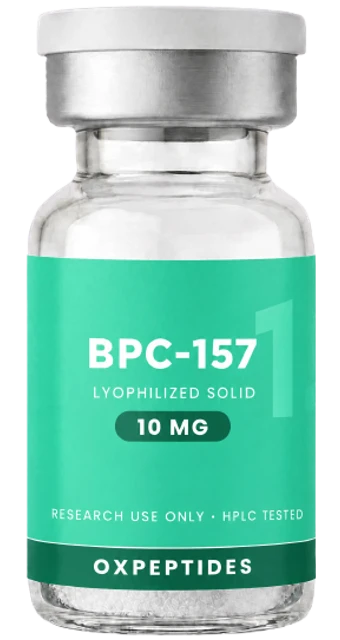
In the catalog
BPC-157
| Size | Price | Per unit |
|---|---|---|
| 10 mg | $50 | $5 / mg |
| 20 mg | $80 | $4 / mg |
| 30 mg | $135 | $4.50 / mg |
Research use only. Not for human or veterinary use. One email when the first batch is listed. No newsletter.
Two compounds, not one product
"BPC-157 and TB-500" is one of the most typed searches in this category, and the wording suggests a single item. It is not. BPC-157 and TB-500 are two different synthetic peptides, made in separate syntheses, filled in separate vials, tested in separate lots. A laboratory that orders both receives two vials, two labels and two certificates of analysis.
- BPC-157 — a 15-residue peptide, sequence Gly-Glu-Pro-Pro-Pro-Gly-Lys-Pro-Ala-Asp-Asp-Ala-Gly-Leu-Val (GEPPPGKPADDAGLV), about 1,419 Da, usually supplied as the acetate salt. Details in the BPC-157 buying guide.
- TB-500 — a trade name, not a sequence: on the research market most often full-length synthetic thymosin β4 (43 amino acids, about 4,963 Da, N-terminal Ac-SDKP), sometimes a shorter fragment of the same protein sold under the same name. The mass on the batch COA identifies which one a lot is. Details in the TB-500 buying guide.
Both are sold in the catalog as research reagents: sealed vials of lyophilized powder, each with its own lot number and batch COA. Research use only. Not for human or veterinary use.
Side by side: what is in each vial
| Field | BPC-157 | TB-500 |
|---|---|---|
| Type | Synthetic 15-amino-acid peptide | Synthetic thymosin β4 (trade name) |
| Sequence | GEPPPGKPADDAGLV | Synthetic thymosin β4 (43 residues) or a shorter fragment — stated on the product page and confirmed by the COA mass |
| Molecular weight | ≈ 1,419 Da | ≈ 4,963 Da (full length); less for a fragment |
| Usual salt form | Acetate | Acetate |
| Appearance | White lyophilized powder | White lyophilized powder |
| Vial sizes in the catalog | 10, 20, 30 mg | 10, 20, 30 mg |
| Container | Glass vial, rubber septum, aluminum crimp cap, printed lot number | |
| COA | Own lot: HPLC purity + mass ≈ 1,419 | Own lot: HPLC purity + mass matching the sequence stated on the product page |
| Sealed storage | −20 °C, protected from light and moisture; 24 months sealed | |
The two powders look identical in the vial. The only way to tell them apart, and to know that each vial holds what its label says, is the mass confirmation on each certificate: one mass near 1,419 Da for BPC-157, and for TB-500 the mass that matches the sequence stated on its product page (about 4,963 Da for full-length thymosin β4).
What each certificate of analysis must show
Because the two compounds are so often ordered in the same parcel, some listings offer one "COA" for the pair. That document cannot exist: a chromatogram describes one lot of one compound. For each of the two vials, the certificate has to carry:
- A named independent laboratory and a test number that can be looked up on the lab's site.
- The lot number printed on that vial — BPC-157 and TB-500 will have different lot numbers.
- HPLC purity as a measured percentage with the chromatogram, not a "≥ 98 %" typed in a table.
- Mass confirmation matching the compound: about 1,419 Da for BPC-157; for TB-500, the mass that matches the sequence stated on the product page (about 4,963 Da for full-length thymosin β4, less for a fragment). Compare the two before ordering.
- The test date, recent enough to describe a lot that is still in stock.
- A photograph of the tested vial wearing the supplier's own label.
How to read each of those fields, and what a re-used or edited certificate looks like, is covered in how to read a peptide COA.
Why laboratories order the two together
The two are frequently ordered together, and the reason is logistical rather than chemical: they come from the same kind of supplier, ship under the same storage conditions, and are documented the same way. Ordering both from one source means one parcel, one set of storage rules, and — with the right supplier — two certificates issued by the same laboratory, which makes them easy to compare.
What to expect from a supplier when both are in the same order:
- Two separate lot numbers, two separate COAs, both verifiable at the lab.
- Labels that state the compound and the net quantity in mg — never a generic "peptide" label.
- The same sealed-vial storage line for both (−20 °C, dark, dry), so the parcel is stored as one.
- Vials packed so that they cannot be mixed up: distinct labels, ideally distinct cap colors.
A listing that sells the pair as a bundle without two lot numbers is selling two unknowns at a discount.
Storage of the sealed vials
Both powders share the catalog's storage line for lyophilized peptides:
- Temperature: −20 °C for long-term storage; a refrigerator (2–8 °C) for short periods.
- Light and moisture: keep the vials sealed, in their box, and let a cold vial reach room temperature before it leaves its bag.
- Shelf life: 24 months from the fill date for a sealed vial stored as above.
Ambient shipping for a few days does not degrade either powder, which is why neither ships with cold packs. The full rules, compound by compound, are in lyophilized peptides: storage and shelf life.
How to choose a supplier for both
The checks are the same as for any research peptide, applied twice:
- Two verifiable batch COAs from a named independent laboratory, each showing the supplier's own label on the tested vial.
- Quantity in mg and lot number printed on each vial.
- Domestic, tracked shipping in a few days.
- A product page that describes the reagent only — composition, purity documentation, storage — with "research use only" stated plainly. A supplier that publishes usage content is a supplier that is easy to shut down while an order is in transit.
- A price at or above the market. Two lots tested by a third party cost several hundred dollars; a pair sold far below the market did not pay for that.
The wider checklist — payment, packaging, what happens if a parcel is stopped — is in where to buy research peptides in the US.
Price: what the catalog offers
Each compound is priced per vial, in three sizes, and the price per milligram is shown next to each size in the live catalog tables. TB-500 costs more per milligram than BPC-157 — a 43-residue peptide is the more expensive synthesis — so the two are never priced as a pair. The table at the top of this page is read from the catalog for BPC-157; the TB-500 table is on its own guide and product page.
Published research
The publications a researcher will find when looking this compound up, with their DOI. They characterize the molecule and the models it was studied in; they are listed as references, not as claims about this product.
Sikiric P, et al. (2018). Current Pharmaceutical Design, 24(18), 4012-4032.
doi:10.2174/1381612824666181112094255
The review most often cited for BPC-157: the origin of the 15-residue sequence, its stability in solution, and the models in which it has been characterized.
Goldstein AL, Kleinman HK (2005). Trends in Molecular Medicine, 11(9), 421-429.
doi:10.1016/j.molmed.2005.07.004
The reference review on thymosin β4, the 43-residue protein sold under the trade name TB-500: its sequence, its actin-binding segment and the models in which it has been characterized.
FAQ
Are BPC-157 and TB-500 the same thing?
Where can I buy BPC-157 and TB-500 together?
Can one COA cover both BPC-157 and TB-500?
How are BPC-157 and TB-500 stored before opening?
What do BPC-157 and TB-500 cost?
Related guides
BPC-157 — buying guide
Sequence and mass, the white lyophilized powder, vial sizes, what a batch COA must show, storage.
Read Buying guideTB-500 — buying guide
What the trade name covers, the white powder, vial sizes, what a batch COA must show, storage.
Read Quality & storageHow to read a peptide COA
What each field must say, how to verify it on the laboratory site, the signs of an edited certificate.
ReadNext step
BPC-157 in the OXpeptides catalog
The first batch is in preparation. One email when it is listed — sizes, price per vial and the batch COA are on the product page.
Research use only. Not for human or veterinary use.