OXpeptides
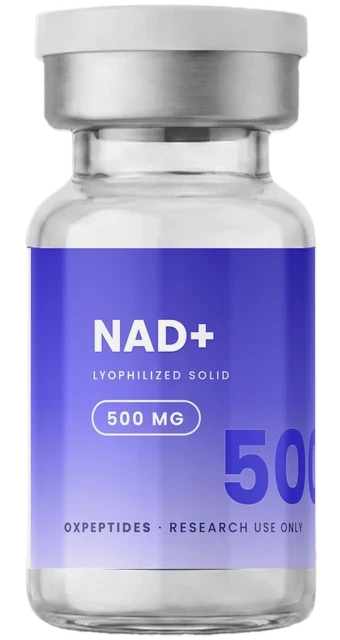
NAD+
Purity >99%Lyophilized
Anti-Aging

NAD+

Nicotinamide Adenine Dinucleotide — sirtuin substrate, DNA repair and longevity

Select pack size

$42free shipping
Buy now
Purity >99%Tracked shippingFast support

About NAD+

NAD+ (Nicotinamide Adenine Dinucleotide) is an essential coenzyme with a molecular weight of 663.4 Da, present in all living cells and playing a central role in energy metabolism, DNA repair and epigenetic gene regulation. NAD+ was first discovered in 1906 by Arthur Harden and William John Young as "cozymase" while investigating alcoholic fermentation — work that earned Harden the 1929 Nobel Prize in Chemistry. The structure was elucidated in the 1930s by Hans von Euler-Chelpin. NAD+ exists in two forms: the oxidized form (NAD+) and the reduced form (NADH), which together function as electron carriers in over 500 enzymatic reactions, including glycolysis, the citric acid cycle and oxidative phosphorylation. Landmark work by Imai & Guarente (Trends in Cell Biology, 2014) and Sinclair (Cell, 2013) shows the age-dependent decline of intracellular NAD+ levels as a causal factor in cellular senescence and mitochondrial dysfunction. NAD+ is the essential substrate of three enzyme families: the sirtuins (SIRT1-7), a family of NAD+-dependent deacetylases that regulate epigenetic modifications, mitochondrial biogenesis and inflammatory responses; the PARP enzymes (Poly-ADP-Ribose Polymerases), essential for DNA repair and genomic stability; and the CD38/CD157 ectoenzymes, which metabolize NAD+ in the context of calcium signaling. The central study by Rajman et al. (Cell Metabolism, 2018) documents improvement of mitochondrial function and stem cell activity through NAD+ supplementation in various animal models. Camacho-Pereira et al. (Cell Metabolism, 2016) identified CD38 as the main driver of age-related NAD+ decline and showed that CD38 knockout mice are protected from age-associated NAD+ loss. Clinical data from Martens et al. (Nature Communications, 2018) show that NAD+ precursors (NR) raise NAD+ levels in healthy older adults by 60% and can reduce systolic blood pressure by 5 mmHg.

Specifications

  • Substrate of sirtuins SIRT1-7 — regulation of epigenetic modifications, mitochondrial biogenesis and inflammation
  • Age-dependent decline of intracellular NAD+ levels via CD38 activity (Camacho-Pereira et al., Cell Metabolism 2016)
  • Essential role in 500+ enzymatic reactions: glycolysis, citric acid cycle and oxidative phosphorylation
  • Substrate of PARP enzymes for DNA repair and genomic stability — critical under DNA damage
  • Improvement of stem cell activity and tissue regeneration in several animal models (Rajman et al., 2018)
  • NAD+ precursors raise NAD+ levels by 60% and reduce systolic blood pressure by 5 mmHg (Martens et al., Nature Comm. 2018)
  • NAD+ depletion as common denominator of neurodegenerative diseases: Alzheimer's, Parkinson's and ALS
  • CD38 knockout mice are protected from age-associated NAD+ loss — CD38 identified as therapeutic target
  • Over 100 years of research history since discovery as "cozymase" by Harden & Young (1906, Nobel Prize 1929)
  • NMN supplementation fully reverses age-related NAD+ decline in the mouse model (Yoshino et al., Science 2011)

Research context

Central review: Rajman et al., "Therapeutic Potential of NAD-Boosting Molecules: The In Vivo Evidence", Cell Metabolism, Volume 27, Pages 529–547 (2018), DOI: 10.1016/j.cmet.2018.02.011. This comprehensive analysis evaluates over 30 preclinical studies on NAD+ precursors and direct NAD+ supplementation. Sirtuin research summarized in Imai & Guarente, "NAD+ and sirtuins in aging and disease", Trends in Cell Biology, Volume 24, Pages 464–471 (2014), DOI: 10.1016/j.tcb.2014.04.002. Age-dependent NAD+ depletion mechanistically clarified in Camacho-Pereira et al., "CD38 Dictates Age-Related NAD Decline and Mitochondrial Dysfunction through an SIRT3-Dependent Mechanism", Cell Metabolism, Volume 23, Pages 1127–1139 (2016), DOI: 10.1016/j.cmet.2016.05.006. First clinical data on NAD+ supplementation in Martens et al., "Chronic nicotinamide riboside supplementation is well-tolerated and elevates NAD+ in healthy middle-aged and older adults", Nature Communications, Volume 9, 1286 (2018). The role of NAD+ in neurodegeneration is described in Lautrup et al. (Nature Reviews Neuroscience, 2019), where NAD+ depletion was identified as a common denominator of Alzheimer's, Parkinson's and ALS. Yoshino et al. (Science, 2011) showed that NMN (Nicotinamide Mononucleotide) can fully reverse the age-related decline of NAD+ levels in the mouse model.

Storage & handling

Temperature

-20°C (lyophilized) / 2–8°C (reconstituted)

Conditions

Protect from direct light and moisture

Shelf life

18 months (lyophilized, sealed vial)

Reconstitution of NAD+

Solvent

Bacteriostatic water (0.9% benzyl alcohol)

Volume

2–5 mL

Concentration

250 mg/mL at 2 mL, 100 mg/mL at 5 mL

Step-by-step

  1. 1Allow the vial and bacteriostatic water to reach room temperature (15–20 minutes).
  2. 2Use an alcohol swab to disinfect the rubber stoppers of both vials.
  3. 3Draw the desired amount of bacteriostatic water (2–5 mL) using a sterile syringe.
  4. 4Place the needle against the side of the vial and let the water run slowly down the inner wall.
  5. 5Gently swirl the vial or roll it between your palms until the powder is fully dissolved. NAD+ usually dissolves quickly — never shake.
  6. 6Visually inspect the clear solution for particulates. Do not use if cloudy.
  7. 7Store reconstituted NAD+ immediately at 2–8°C and use within 14 days. NAD+ is less stable in solution than lyophilized.
  8. 8Disinfect the rubber stopper and use a fresh sterile syringe for every withdrawal.

Frequently asked questions

What is NAD+ and what role does it play in the body?

NAD+ (Nicotinamide Adenine Dinucleotide) is an essential coenzyme in all living cells. It plays a central role in energy metabolism, DNA repair via PARP enzymes and epigenetic regulation via the sirtuin family (SIRT1-7).

Why do NAD+ levels decline with age?

The age-dependent decline of intracellular NAD+ levels is well documented scientifically (Camacho-Pereira et al., Cell Metabolism, 2016). This decrease is considered a causal factor in cellular senescence and impairs mitochondrial biogenesis and DNA repair capacity.

How is NAD+ reconstituted and stored?

The lyophilized NAD+ powder is reconstituted with bacteriostatic water. Store lyophilized at -20°C, reconstituted at 2–8°C. Protect from direct light and moisture.

What is the purity of the NAD+ product?

Our NAD+ is supplied at >99% purity. Every batch undergoes strict quality control to ensure identity, purity and stability of the coenzyme.

In which quantities is NAD+ available?

NAD+ is available as lyophilized powder in 500 mg and 1000 mg variants. Shelf life is 18 months in the sealed vial under correct storage.

Order NAD+

From $42 · Purity >99%· Dispatched within 1 business day

Buy now

New to research peptides?

Read our complete guide to research peptides

Purity, reconstitution, storage, and how to buy research peptides safely — 2,200 words.

Read the guide →