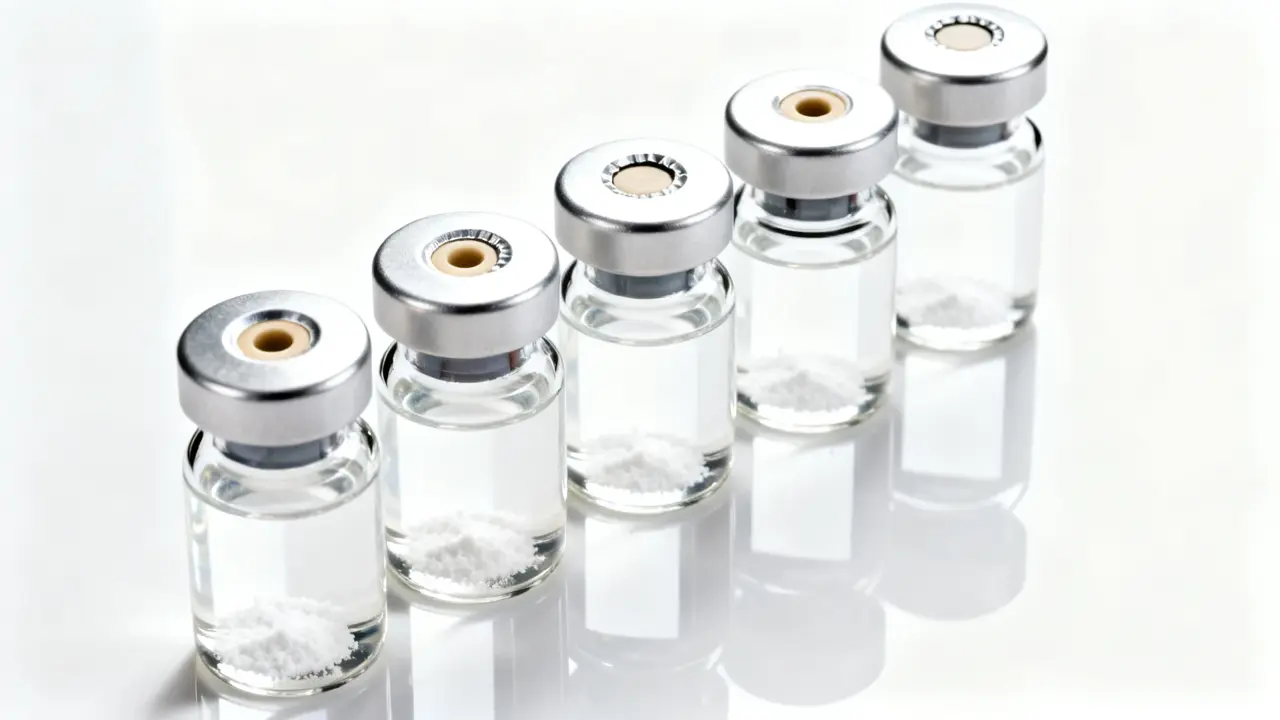
What are research peptides?
Research peptides are short sequences of amino acids — typically 2 to 50 residues — manufactured under solid-phase peptide synthesis (SPPS) conditions for use in laboratory research. A research peptide ships as a lyophilized (freeze-dried) white powder inside a sealed borosilicate glass vial, must be reconstituted with bacteriostatic water before any experiment, and is sold strictly under the "for research use only, not for human or animal use" category. Research peptides sit in a different regulatory category than pharmaceuticals: they are research reagents, not FDA-approved medicines.
The research peptide market has expanded dramatically since 2020. Triple-receptor agonists like retatrutide, published in the New England Journal of Medicine in 2023 with a -24.2% bodyweight effect at 48 weeks, have reframed what a single peptide molecule can do. Older workhorses like BPC-157 now sit on a foundation of 100+ peer-reviewed cytoprotection studies. The practical consequence for researchers: the number of research peptides worth investigating, and therefore worth buying, has never been higher.
Why purity matters more than price
Peptide synthesis is an additive process. Every coupling step has a yield below 100%, so truncated sequences — peptides missing one or more amino acids — accumulate in the crude product. If the supplier does not purify aggressively by preparative HPLC after synthesis, the final vial contains the target peptide plus a cocktail of closely-related impurities. Those impurities do not disappear in your experiment; they become independent variables you did not plan for.
The industry-standard measurement is HPLC (High-Performance Liquid Chromatography) with UV detection at 214 nm. A research peptide labeled ">99% HPLC" means the target peptide accounts for more than 99% of the area under the HPLC trace. Serious suppliers cross-validate with ESI-MS or MALDI-TOF mass spectrometry to confirm that the peak at 99% is in fact the correct molecular mass — not a similar-sized impurity. Every batch of research peptide we ship at OXpeptides carries both numbers on its lot-specific Certificate of Analysis, available on request.
Accept >98% as a minimum. Prefer >99%. Below 98%, you cannot reliably attribute experimental effects to the peptide itself.
The research peptide compounds worth knowing in 2026
The ten compounds below are the ones we keep continuously in stock. The table summarises what each one is and what the published literature investigates; the sections that follow give the detail and the citations.
| Compound | Family / origin | What the literature studies | Dedicated guide |
|---|---|---|---|
| Retatrutide (LY3437943) | Synthetic triple receptor agonist | Simultaneous GLP-1, GIP and glucagon receptor activation; adipose thermogenesis, hepatic steatosis, insulin sensitivity (Jastreboff et al., NEJM 2023) | Retatrutide guide |
| MOTS-c | Endogenous 16-amino-acid peptide encoded in the mitochondrial 12S rRNA gene | AMPK activation and systemic metabolic homeostasis; mitochondrial dysfunction and aging-related metabolic research | MOTS-c guide |
| BPC-157 | 15-residue pentadecapeptide derived from human gastric juice protein | VEGF-mediated angiogenesis and nitric oxide system modulation; cytoprotection across 20+ tissue types (Sikiric et al., 2018) | BPC-157 guide |
| TB-500 | Synthetic fragment of Thymosin Beta-4, an actin-sequestering protein | Cell migration, angiogenesis and tissue regeneration in muscle, tendon and corneal epithelium | TB-500 guide |
| GHK-Cu | Naturally-occurring copper tripeptide (glycyl-histidyl-lysine-copper) present in human plasma | Dermal matrix remodeling, anti-oxidant response regulation and wound-healing signaling (Pickart et al.) | GHK-Cu guide |
| AHK-Cu | Copper tripeptide variant (alanyl-histidyl-lysine-copper) | Follicular and angiogenic research | Copper peptides guide |
| Selank | Synthetic heptapeptide derived from tuftsin | Anxiolytic-like and nootropic properties without benzodiazepine-class sedation | Semax vs Selank |
| Semax | ACTH(4-10) analogue of Russian origin | BDNF expression modulation; cognitive and neuroprotective research endpoints | Semax vs Selank |
| NAD+ | Endogenous coenzyme | Sirtuin-pathway activity, DNA repair and cellular energy metabolism | — |
| Bacteriostatic water | Diluent (0.9% benzyl alcohol), stocked in 10 mL and 30 mL vials | Standard diluent for reconstituting every research peptide above | Reconstitution guide |
Metabolic research — Retatrutide and MOTS-c
Retatrutide (LY3437943) is the first triple agonist to reach late-stage clinical research, simultaneously activating GLP-1, GIP and glucagon receptors. The NEJM Phase II trial by Jastreboff et al. (2023) documented a mean -24.2% reduction in bodyweight over 48 weeks — the strongest effect ever reported for a single peptide. Phase III under the TRIUMPH program is enrolling 4,000+ subjects across 45 centers worldwide. For metabolic research into adipose thermogenesis, hepatic steatosis (up to -80% liver fat in mouse models per Coskun et al., Cell Metabolism 2022) and insulin sensitivity, retatrutide is the flagship research peptide of this decade.
MOTS-c sits on the opposite end of the metabolic research spectrum. A 16-amino-acid peptide encoded within the mitochondrial 12S rRNA gene, MOTS-c signals AMPK activation and plays a role in systemic metabolic homeostasis. Where retatrutide intervenes pharmacologically, MOTS-c is an endogenous regulator — a research peptide of choice for mitochondrial dysfunction and aging-related metabolic research. The folate/AICAR route to AMPK activation, what the mouse and exercise literature reports and its anti-doping status are covered in the MOTS-c mechanism and research guide.
Regeneration — BPC-157 and TB-500
BPC-157 (Body Protection Compound-157) is a 15-residue pentadecapeptide derived from human gastric juice protein. With more than 100 peer-reviewed studies across 20+ tissue types (Sikiric et al., Current Pharmaceutical Design 2018), BPC-157 is among the most thoroughly characterized cytoprotective research peptides. Its mechanism centers on VEGF-mediated angiogenesis and nitric oxide system modulation. In the classic Staresinic et al. 2006 rat model, BPC-157 restored a transected Achilles tendon to full functional recovery within 72 days. A Phase II clinical trial for oral use in ulcerative colitis (NCT05000399) was initiated in 2021.
TB-500 is a synthetic fragment of Thymosin Beta-4, an actin-sequestering protein expressed in every mammalian cell type. Research models show TB-500 accelerates cell migration, angiogenesis and tissue regeneration particularly in muscle, tendon and corneal epithelium. BPC-157 and TB-500 are frequently co-investigated in regenerative research protocols, though they operate through distinct molecular pathways.
Dermal research — GHK-Cu and AHK-Cu
GHK-Cu (glycyl-histidyl-lysine-copper) is a naturally-occurring copper tripeptide present in human plasma at concentrations that decline with age. Pickart et al. documented its role in dermal matrix remodeling, anti-oxidant response regulation and wound-healing signaling. GHK-Cu arrives as a characteristic dark cobalt-blue lyophilized powder — the color comes from the copper coordination, not a dye. Its sibling AHK-Cu(alanyl-histidyl-lysine-copper) is a variant more studied for follicular and angiogenic research.
Neurocognitive research — Selank and Semax
Selank is a synthetic heptapeptide derived from tuftsin, originally developed at the V. N. Orekhovich Institute of Biomedical Chemistry. Selank has been studied for anxiolytic-like and nootropic properties without the sedation characteristic of benzodiazepine-class anxiolytics. Semax, an ACTH(4-10) analogue also of Russian origin, modulates BDNF expression and has been investigated for cognitive and neuroprotective research endpoints. Both research peptides are administered intranasally in published research protocols.
NAD+ and bacteriostatic water
NAD+ is the essential coenzyme for sirtuin-pathway activity, DNA repair, and cellular energy metabolism. It is stocked alongside our research peptides because NAD+ protocols frequently accompany peptide research workflows in longevity and metabolic studies. Bacteriostatic water (0.9% benzyl alcohol USP) is the standard diluent for reconstituting every research peptide above, and is stocked in 10 mL and 30 mL vials. For US-based laboratories sourcing bacteriostatic water separately from a dedicated single-SKU supplier, the bacteriostatic water guide (US) details 0.9 % benzyl-alcohol specifications, reconstitution SOP, and multidose-vial handling.
How to reconstitute a research peptide correctly
- Allow both the lyophilized vial and the bacteriostatic water vial to reach room temperature (15-20 minutes out of the freezer).
- Wipe the rubber stoppers of both vials with an isopropanol swab.
- Draw the required volume of bacteriostatic water into a sterile insulin syringe. Typical reconstitution for 10 mg peptide: 1-2 mL of diluent.
- Insert the needle through the peptide vial stopper at an angle and release the water slowly against the inner glass wall — never aim the stream directly onto the lyophilized cake.
- Cap the vial and swirl gently, or roll between your palms, until the powder fully dissolves. Do not shake. Shaking introduces shear forces that can denature the peptide structure.
- Visually inspect the solution. It should be clear. Any cloudiness, fibrils or visible particles indicates a problem — do not use.
- Store the reconstituted research peptide at 2-8°C (refrigerator), protected from direct light, and use within 28 days.
Storage of lyophilized vs reconstituted peptides
A sealed lyophilized research peptide vial is remarkably stable: at -20°C protected from light and moisture, shelf life typically exceeds 18 months and often reaches 24 months. Short-term (up to 30 days) storage at 2-8°C is acceptable for vials in active use. Once reconstituted, the stability clock starts: most peptides at 2-8°C in bacteriostatic water retain full potency for 14-28 days. For longer storage of reconstituted peptide, aliquot into sterile cryovials and freeze at -80°C — avoid repeated freeze-thaw cycles which accumulate damage.
| Form | Temperature | Working window | Precautions |
|---|---|---|---|
| Lyophilized, sealed vial (long-term) | -20°C | Typically >18 months, often 24 months | Protect from light and moisture |
| Lyophilized, sealed vial (in active use) | 2-8°C | Up to 30 days | Short-term storage only |
| Reconstituted in bacteriostatic water | 2-8°C (refrigerator) | 14-28 days | Protect from direct light; swirl, never shake; discard if cloudy or particulate |
| Reconstituted, aliquoted into sterile cryovials | -80°C | — | Avoid repeated freeze-thaw cycles, which accumulate damage |
| Reconstituted, left out (not recommended) | Room temperature | ~7 days instead of 28 | Cuts useful life fourfold; a common and avoidable mistake |
How to buy research peptides safely
The research peptide supplier landscape includes excellent vendors and genuinely dangerous ones. Use this five-point checklist when evaluating any source before you buy research peptides:
- Purity disclosure: >99% HPLC with lot-specific COA available. A supplier that cannot produce a COA has not done HPLC.
- Mass spec confirmation: Cross-validation by ESI-MS or MALDI-TOF. HPLC alone does not confirm molecular identity.
- Packaging integrity: Lyophilization under nitrogen, crimp-sealed borosilicate glass vials. A slight vacuum release on first puncture is correct and expected.
- Transparent framing: "For research use only. Not for human or animal use." stated plainly, not hidden in a disclaimer at the bottom of a page.
- Tracked logistics: Real tracking numbers, real carriers, plain discreet outer packaging. A supplier that drop-ships with no tracking has no accountability.
OXpeptides hits all five. Our research peptides cataloglists ten compounds we keep continuously in stock, all at >99% HPLC purity, all with COAs on request, shipped with tracked plain packaging and delivered in 4 to 7 days across the EU, EEA and Switzerland. See our full product catalog for dosing strengths and pricing.
Researchers located in the German-speaking EU — where AMG § 2 and HWG impose distinct labelling rules on research reagents — will find the local regulatory framework explained in detail in this Peptide kaufen — deutscher Ratgeber.
Common mistakes researchers make
- Buying by price alone. A 50% cheaper research peptide at 92% purity costs you far more in failed experiments than it saves upfront.
- Shaking on reconstitution. Destroys the tertiary structure of many peptides. Always swirl.
- Storing reconstituted peptide at room temperature. Cuts useful life from 28 days to ~7 days.
- Using non-bacteriostatic water. Plain sterile water lacks preservative and supports microbial growth within days.
- Skipping the COA. If you do not have a paper trail linking the vial in your hand to an HPLC trace, you have no traceability.
FAQ
What exactly are research peptides?
Research peptides are short chains of 2-50 amino acids synthesized under controlled conditions for laboratory investigation. They arrive as lyophilized (freeze-dried) white powder in sealed glass vials and are classified as research chemicals, not pharmaceuticals.
Are research peptides legal to buy?
Yes, research peptides can be lawfully purchased in the United States and most of Europe as research reagents labeled "not for human or animal use." They are not FDA-approved medicines. Buyers are responsible for local compliance.
What purity should I accept?
At minimum >98% by HPLC. Serious suppliers document >99% and cross-verify with mass spectrometry. Anything below 98% risks meaningful contamination by truncated sequences and synthesis byproducts that confound research results.
Which research peptides are most studied in 2026?
Retatrutide (triple GLP-1/GIP/glucagon agonist, NEJM 2023), BPC-157 (100+ cytoprotection studies), TB-500 / Thymosin Beta-4 fragment, GHK-Cu for dermal research, MOTS-c for mitochondrial research, and Semax / Selank for neurocognitive research.
How long do reconstituted research peptides remain stable?
In bacteriostatic water at 2-8°C, most research peptides maintain potency for 14-28 days. Lyophilized sealed vials stored at -20°C remain stable 12-24 months, sometimes longer depending on the sequence.
Compound-specific guides
- BPC-157 research guide — mechanisms, preclinical data and handling.
- BPC-157 dosage in research models — reconstitution and concentration math.
- TB-500 (Thymosin β-4 fragment) explained — angiogenesis and tissue-repair research.
- The retatrutide triple-agonist guide — GLP-1/GIP/glucagon and the NEJM phase-2 data.
- Where to buy retatrutide for research — purity benchmarks and COA checks.
- Tesamorelin and the GHRH axis — visceral-fat research background.
- The quintuple agonist (GLP-1/GIP/PPAR) — the next metabolic frontier.
New to the field? Start with our how-to-buy-research-peptides-online walkthrough, then check whether peptides are legal where you are — the research-use classification explained with the primary legislation.
Further reading — primary literature
- Jastreboff A.M. et al. "Triple-Hormone-Receptor Agonist Retatrutide for Obesity — A Phase 2 Trial." New England Journal of Medicine 389, 514-526 (2023). DOI: 10.1056/NEJMoa2301972.
- Coskun T. et al. "LY3437943, a novel triple GIP, GLP-1, and glucagon receptor agonist." Cell Metabolism 34, 1234-1247 (2022). DOI: 10.1016/j.cmet.2022.07.013.
- Sikiric P. et al. "Stable Gastric Pentadecapeptide BPC 157: Novel Therapy in Gastrointestinal Tract." Current Pharmaceutical Design 24, 4012-4032 (2018). DOI: 10.2174/1381612824666181112094255.
- Chang C.-H. et al. "BPC-157 effects on neuroprotection via GABAergic modulation." Life Sciences 284, 119892 (2021).
- Pickart L., Margolina A. "Regenerative and Protective Actions of the GHK-Cu Peptide." International Journal of Molecular Sciences 19, 1987 (2018).