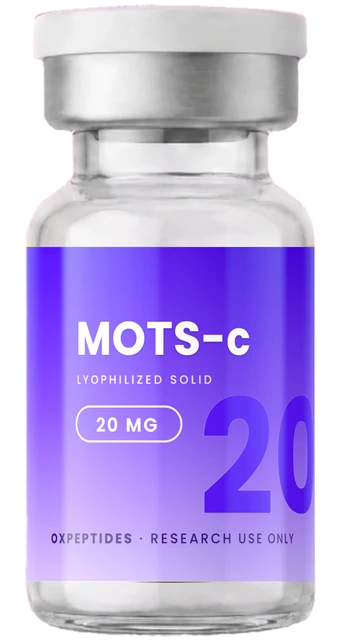
MOTS-c
Mitochondrial peptide — AMPK activation, longevity and metabolic regulation
Select pack size
About MOTS-c
MOTS-c (Mitochondrial Open Reading Frame of the 12S rRNA Type-c) is a 16-amino-acid peptide with the sequence MRWQEMGYIFYPRKLR, encoded in the mitochondrial genome — one of the few known mitochondrial-derived peptides (MDPs). It was first described in 2015 by Changhan Lee and Pinchas Cohen at the Leonard Davis School of Gerontology (University of Southern California) and has since revolutionized the understanding of mitochondrial retrograde signaling. MOTS-c is not merely a passive metabolic product: it functions as an active signaling molecule that transmits metabolic information from the mitochondrion to the nucleus. The primary mechanism of action is based on activation of the AMPK signaling cascade (AMP-activated protein kinase), the central energy sensor of the cell. Through AMPK activation, MOTS-c regulates folate metabolism and the methionine cycle, which in turn influences de novo purine biosynthesis and modulates the cellular nucleotide pool. Notable is the translocation of the peptide from the mitochondrion to the nucleus under metabolic stress — a mechanism described in 2018 by Kim et al. (Cell Metabolism), in which MOTS-c binds to regulatory DNA regions (ARE, Antioxidant Response Elements) and acts as a genomic regulator. Studies show a marked age-dependent decline in endogenous MOTS-c levels: D'Souza et al. (Aging Cell, 2020) documented a decline of approximately 30% between ages 20 and 70 in skeletal muscle tissue. In animal studies, exogenous MOTS-c improves glucose tolerance, increases skeletal muscle performance and protects against age-related insulin resistance. Reynolds et al. (Aging, 2021) showed that MOTS-c injections in older mice increased running performance by 25% and significantly increased muscle fiber size. The peptide is supplied as lyophilized powder and, due to its unique position at the intersection of mitochondrial biology, epigenetics and metabolism, is one of the most fascinating molecules in longevity research.
Specifications
- Activation of the AMPK signaling cascade and improvement of insulin sensitivity via folate-metabolism regulation
- Nuclear translocation under metabolic stress — binding to ARE elements as a genomic regulator (Kim et al., 2018)
- Age-dependent decline of endogenous levels by ~30% between ages 20 and 70 (D'Souza et al., Aging Cell 2020)
- Regulation of the folate-methionine cycle and de novo purine biosynthesis — nucleotide-pool modulation
- 25% improvement in skeletal muscle performance and increased muscle fiber size in older mice (Reynolds et al., 2021)
- One of the few known mitochondrial-derived peptides (MDPs) — a unique signaling category
- Protection against age-related insulin resistance and improved glucose tolerance in the animal model
- Polymorphisms in the 12S rRNA gene associated with longevity in Japanese centenarians (Zempo et al., 2021)
- Retrograde signaling from mitochondrion to nucleus — a paradigmatically new concept of intercellular communication
- Potential role as biomarker for mitochondrial health and biological age
Research context
First described in Lee et al., "The Mitochondrial-Derived Peptide MOTS-c Promotes Metabolic Homeostasis and Reduces Obesity and Insulin Resistance", Cell Metabolism, Volume 21, Pages 443–454 (2015), DOI: 10.1016/j.cmet.2015.02.009. This groundbreaking study showed for the first time that a mitochondrially encoded peptide can act as a systemic metabolic regulator. Nuclear translocation under metabolic stress was described in Kim et al., "Mitochondrial-derived peptide MOTS-c translocates to the nucleus to regulate nuclear gene expression in response to metabolic stress", Cell Metabolism, Volume 28, Pages 516–524 (2018), DOI: 10.1016/j.cmet.2018.06.008. Age-dependent levels comprehensively published in D'Souza et al., "Decline of MOTS-c with age in human skeletal muscle", Aging Cell, Volume 19, e13253 (2020), DOI: 10.1111/acel.13253. Effects on skeletal musculature and physical performance in Reynolds et al., "MOTS-c is an exercise-induced mitochondrial-encoded regulator of age-dependent physical decline and muscle homeostasis", Nature Communications, Volume 12, 470 (2021). An epidemiological study by Zempo et al. (Scientific Reports, 2021) identified polymorphisms in the mitochondrial 12S rRNA gene associated with exceptional longevity in Japanese centenarians, underscoring the role of MOTS-c in human aging.
Storage & handling
Temperature
-20°C (lyophilized) / 2–8°C (reconstituted)
Conditions
Protect from direct light and moisture
Shelf life
18 months (lyophilized, sealed vial)
Reconstitution of MOTS-c
Solvent
Bacteriostatic water (0.9% benzyl alcohol)
Volume
1–2 mL
Concentration
10 mg/mL at 1 mL, 5 mg/mL at 2 mL
Step-by-step
- 1Allow the vial and bacteriostatic water to reach room temperature (15–20 minutes).
- 2Use an alcohol swab to disinfect the rubber stoppers of both vials.
- 3Draw the desired amount of bacteriostatic water (1–2 mL) using a sterile 1-mL insulin syringe.
- 4Place the needle against the side of the vial and let the water run slowly down the inner wall.
- 5Gently swirl the vial or roll it between your palms until the powder is fully dissolved. Never shake.
- 6Visually inspect the clear solution for particulates. Do not use if cloudy or if particles are present.
- 7Store reconstituted MOTS-c immediately at 2–8°C and use within 14 days.
- 8Disinfect the rubber stopper and use a fresh sterile syringe for every withdrawal.
Frequently asked questions
What is MOTS-c and where does it come from?
MOTS-c is a 16-amino-acid peptide encoded in the mitochondrial genome. It was first described in 2015 by Lee et al. in Cell Metabolism and is considered a key mediator of mitochondrial retrograde signaling to the nucleus.
How does MOTS-c affect metabolism?
MOTS-c activates the AMPK signaling cascade, regulates folate metabolism and improves insulin sensitivity. Under metabolic stress, the peptide translocates from the mitochondrion to the nucleus, where it acts as a genomic regulator.
Why is MOTS-c interesting for longevity research?
Studies show an age-dependent decline in endogenous MOTS-c levels. This natural decrease correlates with metabolic aging processes and makes MOTS-c a promising research target in the field of longevity science.
How is MOTS-c stored and reconstituted?
Store lyophilized MOTS-c at -20°C. For reconstitution, inject bacteriostatic water slowly against the vial wall and swirl gently. Keep reconstituted solution at 2–8°C and protect from light.
Is MOTS-c available as a research peptide?
Yes, MOTS-c is available as a research chemical for scientific purposes. Shipment is temperature-controlled. It is not an approved drug and is intended exclusively for in-vitro research.
Order MOTS-c
From $130 · Purity >99%· Dispatched within 1 business day
New to research peptides?
Read our complete guide to research peptides
Purity, reconstitution, storage, and how to buy research peptides safely — 2,200 words.