Sermorelin peptide: sequence, how it is supplied, COA, sizes
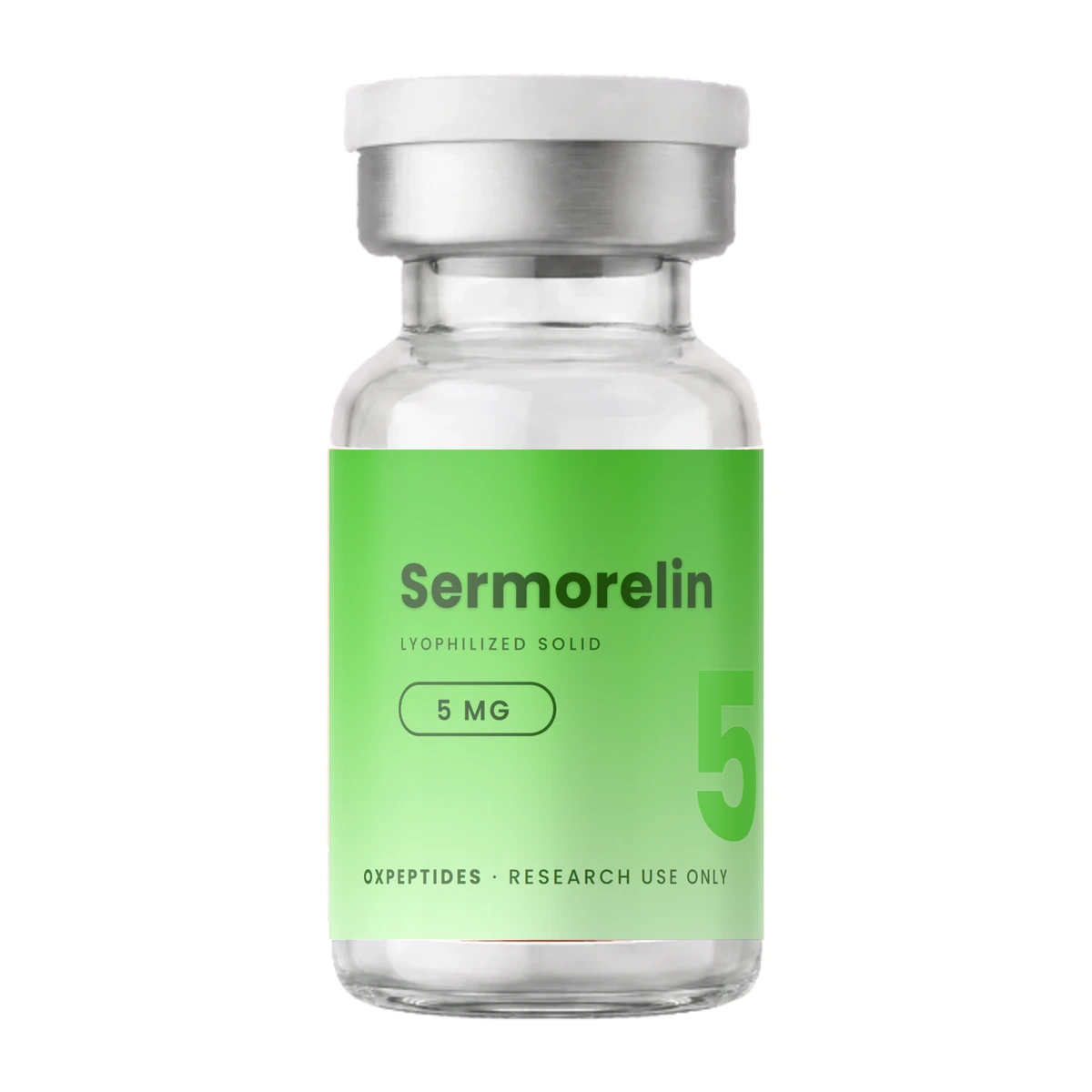
In the catalog
Sermorelin
from $55.25subscription −15%, or $65 one-time
Purity >99% by HPLC — measured value on each lot's COA
| Size | Subscription | One-time | Per mg |
|---|---|---|---|
| 5 mg | $55.25 | $65 | $11.05/mg |
Research use only. Not for human or veterinary use. Availability is on the product page.
Sermorelin is the synthetic peptide corresponding to residues 1 to 29 of growth-hormone-releasing hormone (GHRH), 3,357.9 g/mol, supplied as a white lyophilized powder in a sealed 5 mg vial. It is the unmodified sequence: Mod GRF 1-29 carries four substitutions, and CJC-1295 DAC adds a thirtieth residue with an albumin-binding linker. It is bought as a laboratory reagent with a batch certificate of analysis (HPLC purity, mass spectrometry identity).
What sermorelin is
Sermorelin is a synthetic peptide of 29 amino acids. Its sequence is the first 29 residues of growth-hormone-releasing hormone (GHRH), the 44-residue peptide first isolated in 1982.
The fragment was chosen because those 29 residues are the shortest stretch that keeps the full receptor-binding sequence of the parent molecule; residues 30 to 44 add nothing to it.
| Property | Value |
|---|---|
| Sequence | Tyr-Ala-Asp-Ala-Ile-Phe-Thr-Asn-Ser-Tyr-Arg-Lys-Val-Leu-Gly-Gln-Leu-Ser-Ala-Arg-Lys-Leu-Leu-Gln-Asp-Ile-Met-Ser-Arg-NH2 |
| Length | 29 residues, C-terminal amide |
| Formula | C149H246N44O42S |
| Mass (free peptide) | 3,357.9 g/mol |
| Salt form supplied | Acetate |
| Other names | GHRH 1-29, GRF 1-29 NH2, sermorelin acetate |
| Appearance | White lyophilized powder |
The same 29-residue sequence was for a time sold as a licensed diagnostic reagent under the name Geref. That product was withdrawn from the market in 2008 for commercial reasons, not analytical ones.
What is sold today under the name sermorelin is the identical sequence, made by solid-phase synthesis, purified by preparative HPLC and freeze-dried. Research use only. Not for human or veterinary use.
Sermorelin, Mod GRF 1-29 and CJC-1295 DAC: three sequences, not one
Search listings mix three names as if they were interchangeable. They are three different molecules, and a certificate of analysis distinguishes them by mass in one line.
| Sermorelin | Mod GRF 1-29 (CJC-1295 without DAC) | CJC-1295 DAC | |
|---|---|---|---|
| Residues | 29 | 29 | 30 |
| Changes to the GHRH sequence | none | D-Ala2, Gln8, Ala15, Leu27 | the same four, plus Lys30 carrying a maleimidopropionic-acid linker |
| Mass | 3,357.9 g/mol | 3,367.9 g/mol | 3,647.3 g/mol |
| Why the changes exist | — | the four substitutions block the enzymatic cleavage sites of the native sequence | the linker binds serum albumin, which keeps the peptide in circulation for days rather than minutes |
| Catalog | sermorelin | as part of the CJC-1295 / Ipamorelin blend | CJC-1295 DAC |
A vial labeled "sermorelin" whose mass spectrum shows 3,367.9 is Mod GRF 1-29; one that shows 3,647.3 is CJC-1295 DAC.
The ten-dalton gap between sermorelin and Mod GRF is small but well inside what any mass spectrometer resolves, which is why the certificate, not the label, is the document that identifies the reagent.
The two modified sequences have their own guide: CJC-1295 DAC, Mod GRF 1-29 and the Ipamorelin blend.
What is in the vial
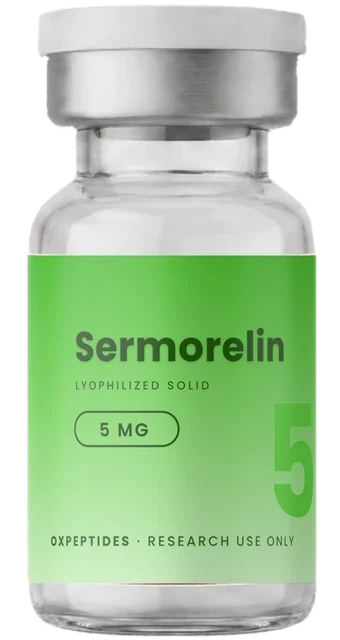
The catalog supplies sermorelin in a 5 mg vial: a 3 mL borosilicate glass vial with a bromobutyl septum and an aluminum crimp cap, holding a white lyophilized cake at the bottom.
The label states the name, the quantity, a lot number and "research use only".
Five milligrams of a 3.4 kDa peptide is 1.5 micromoles, a thin white film rather than a visible pile.
A "5 mg" vial with a thick layer of powder has been filled with a bulking excipient (mannitol is the usual one), which is legitimate only if the certificate reports the net peptide content, the share of the mass that is peptide rather than counter-ion, water and excipient.
For a peptide of this length, net content of 80 to 90 % is typical: acetate counter-ions on the five basic residues (three arginines, two lysines) and residual water account for the rest.
The peptide contains one methionine (position 27).
Methionine oxidizes to its sulfoxide when the powder is exposed to air over time, which appears on an HPLC trace as a small peak eluting just before the main one.
A freshly tested lot shows that peak below 1 %; a lot stored open or warm shows it growing. It is the one impurity specific to this sequence worth reading on the certificate.
Reading the sermorelin certificate of analysis
A sermorelin COA from an independent laboratory carries three measurements. Each one answers a different question.
HPLC purity: one main peak
On reverse-phase HPLC the peptide elutes as a single main peak; the purity figure is the area of that peak as a percentage of all peaks.
Above 99 % is the specification for the catalog lots.
The methionine-sulfoxide shoulder described above and the deletion sequences that solid-phase synthesis leaves behind (a chain missing one residue) are the impurities being counted.
Mass spectrometry: 3,357.9
A peptide of this size is seen by electrospray ionization as multiply charged ions rather than as the bare molecule.
The report lists the observed ions and the deconvoluted mass; for sermorelin the expected values are roughly m/z 1,120.3 for [M+3H]3+ and 840.5 for [M+4H]4+, both reconstructing to 3,357.9.
Any other deconvoluted mass is a different peptide.
Net peptide content, water, endotoxin
Net content (by amino-acid analysis or UV) tells how many of the labeled milligrams are peptide.
Water (Karl Fischer) is typically 3 to 8 % in a lyophilized cake. Endotoxin (LAL) is reported in EU per milligram; it says whether the water and glassware used in the fill were clean.
What else must be on the page
- The laboratory's name and a verifiable test number. Janoshik Analytical is the reference in this market; its reports can be looked up on the laboratory's own site.
- The lot number, identical to the one printed on the vial you receive.
- The test date and a photograph of the tested vial wearing the supplier's label. A certificate for a bare manufacturer's vial says nothing about the finished product.
The OXpeptides certificates are published per lot in the COA library and on the sermorelin product page as each lot comes back from the laboratory. The field-by-field method is in how to read a peptide COA.
Sizes and price: what the catalog offers
Sermorelin is stocked in one size, 5 mg, the format the laboratory certifies lot by lot. The catalog card at the top of this page reads the live price.
Volume tiers apply from two vials (−5 % from 2, −8 % from 3), which is how a laboratory that needs 10 or 15 mg buys it, and the subscription price applies to every delivery.
What the price includes at OXpeptides: a sealed, labeled vial from a tested lot, its batch COA, and a replacement if the parcel arrives lost or damaged.
Ships from France (EU) and California (US) · tracked, tracked: $19, free from $150.
Storage of the sealed vial
- Temperature: −20 °C for long-term storage; a refrigerator (2 to 8 °C) for a few weeks.
- Light, moisture, oxygen: keep the vial sealed and in its box. Because of the methionine at position 27, this sequence is one of those where oxygen matters: a vial that has been opened and left at room temperature will show the sulfoxide peak growing on a later HPLC run.
- Condensation: let a cold vial reach room temperature before it leaves its bag, so no water condenses on the glass.
- Shelf life: 24 months for a sealed lyophilized vial stored cold; the date on the label governs.
A few days of ambient shipping do not degrade the sealed powder, which is why research peptides travel without cold packs. The rules compound by compound are in lyophilized peptides: storage and shelf life.
How to check a sermorelin listing
"Sermorelin" returns clinics, telehealth pages and encyclopedic articles before it returns a research supplier. For a laboratory that needs the reagent, the listing that matters answers five questions on the page itself.
- Which molecule is it? Sermorelin, Mod GRF 1-29 and CJC-1295 DAC are three masses. The page must name one and the certificate must show its mass.
- Is there a batch COA from a named independent laboratory, verifiable on the lab's site, with HPLC purity, mass and net content?
- Does the COA show the supplier's own labeled vial, and does its lot number match the vial you receive?
- Does the vial ship from domestic stock, tracked, in a few days? The catalog ships from California to the US and from France to Europe.
- Does the page describe the reagent only (sequence, purity documentation, storage), with "research use only" stated plainly? A supplier that publishes usage content is a supplier that is easy to shut down, and that risk lands on the buyer whose parcel is in transit.
The seven-point method, with what a re-used or edited certificate looks like, is in how to check a peptide supplier. The wider US checklist is in where to buy research peptides in the US.
Published research
The publications a researcher will find when looking this compound up, with their DOI. They characterize the molecule and the models it was studied in; they are listed as references, not as claims about this product.
Prakash A, Goa KL (1999). BioDrugs.
doi:10.2165/00063030-199912020-00007
The reference review of the molecule: sequence, origin as the 1-29 fragment of GHRH, and the analytical methods that characterize it.
Walker RF (2006). Clinical Interventions in Aging.
A short editorial that documents the history of the peptide and its withdrawal from the market as a licensed product.
FAQ
What is sermorelin?
What is the difference between sermorelin and CJC-1295?
What sizes does sermorelin come in?
What should a sermorelin COA show?
Why does sermorelin need to be kept away from air?
How is sermorelin stored?
Related guides
CJC-1295 & Ipamorelin: each vial
DAC or no DAC, alone or blended with Ipamorelin: the three masses, the two-peak COA, the 5 mg and 10 mg vials.
Read Quality & storageHow to read a peptide COA
What each field must say, how to verify it on the laboratory site, the signs of an edited certificate.
Read Quality & storageLyophilized peptides: storage and shelf life
What lyophilization is, the four things that degrade a peptide, storage temperature and shelf life.
ReadNext step
Sermorelin in the OXpeptides catalog
Sizes, price per vial, the batch COA and current availability are on the product page.
See Sermorelin in the catalogResearch use only. Not for human or veterinary use.