GHK‑Cu vs AHK‑Cu: the two copper tripeptides compared, atom by atom
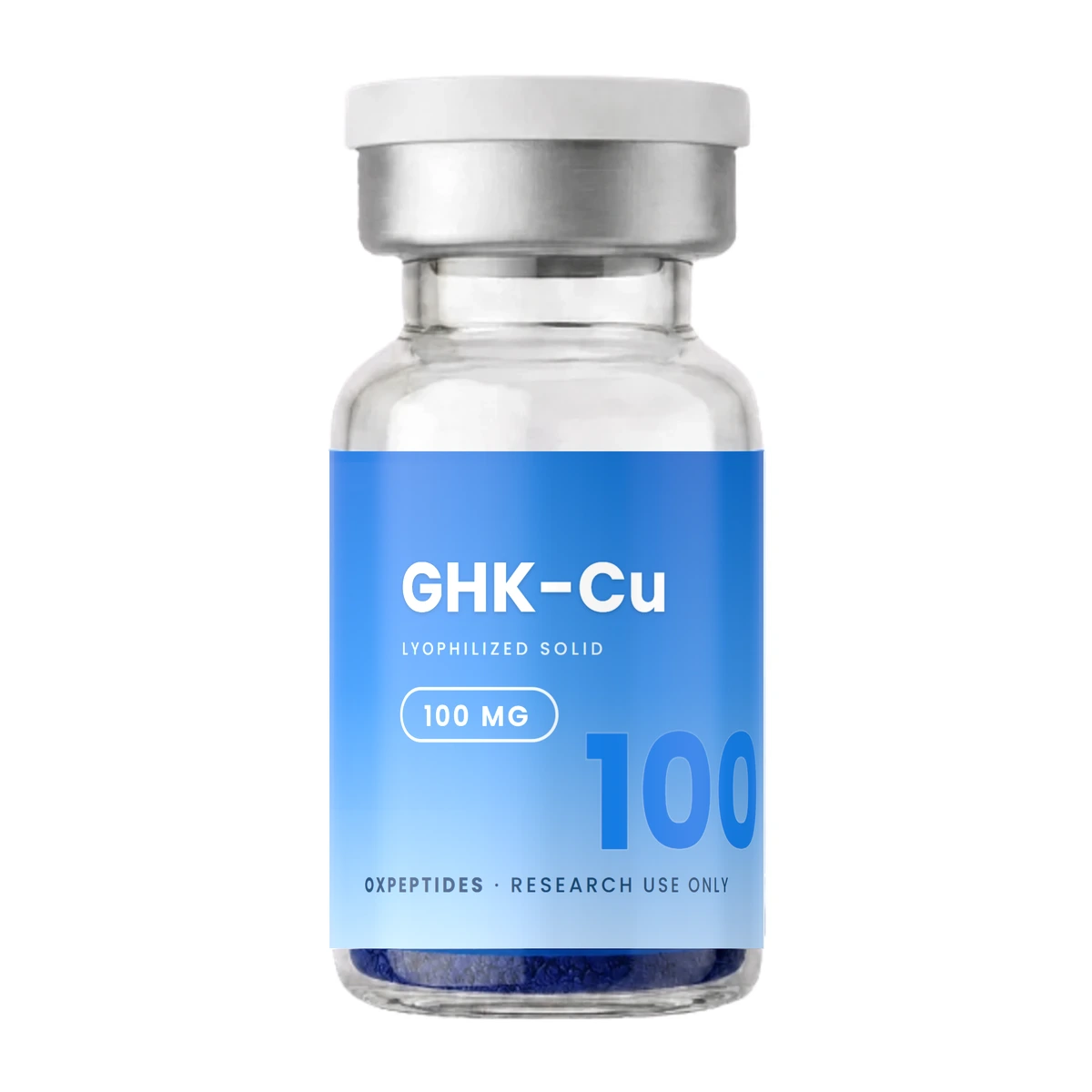
In the catalog
GHK‑Cu
from $34subscription −15%, or $40 one-time
Purity >99% by HPLC — measured value on each lot's COA
| Size | Subscription | One-time | Per mg |
|---|---|---|---|
| 100 mg | $34 | $40 | $0.34/mg |
| 200 mg | $54.40 | $64 | $0.27/mg |
| 300 mg | $77.35 | $91 | $0.26/mg |
Research use only. Not for human or veterinary use. Availability is on the product page.
GHK‑Cu and AHK‑Cu are copper(II) complexes of two tripeptides that differ by one residue: glycine in GHK (Gly-His-Lys, 340.4 g/mol free, 403.9 g/mol as the complex, CAS 89030-95-5) and alanine in AHK (Ala-His-Lys, 354.4 g/mol free, about 417.9 g/mol as the complex, CAS 682809-81-0). Both are supplied as blue-violet lyophilized powders; GHK‑Cu has decades of published characterization and is sold in 100 to 300 mg vials, AHK‑Cu has a handful of papers and is sold in 50 to 150 mg vials. On a certificate of analysis, the 14 Da difference in mass is what tells them apart.
One methyl group apart
Line the two sequences up and the difference is a single carbon.
- GHK = glycyl-L-histidyl-L-lysine. Glycine, the first residue, has a hydrogen as its side chain.
- AHK = L-alanyl-L-histidyl-L-lysine. Alanine has a methyl group (CH3) where glycine has a hydrogen.
That methyl group adds 14 Da (CH2) to the mass and introduces a chiral center at the first residue.
Everything else is identical: the histidine in the middle, whose imidazole ring is what binds copper, and the lysine at the end. Each tripeptide is then complexed with one copper(II) ion to give GHK‑Cu and AHK‑Cu.
GHK was isolated from plasma in 1973 by Loren Pickart, which is why it has fifty years of chemistry behind it.
AHK is a synthetic analogue that appeared in the cosmetic-ingredient literature in the 2000s. Both are made today by solid-phase synthesis; neither is extracted from anything. Research use only. Not for human or veterinary use.
Side by side: the numbers
| GHK‑Cu | AHK‑Cu | |
|---|---|---|
| Sequence | Gly-His-Lys · Cu(II) | Ala-His-Lys · Cu(II) |
| Formula, free peptide | C14H24N6O4 | C15H26N6O4 |
| Mass, free peptide | 340.4 g/mol | 354.4 g/mol |
| Formula, copper complex (PubChem) | C14H24CuN6O4 | C15H26CuN6O4 |
| Mass, copper complex | 403.9 g/mol | about 417.9 g/mol |
| CAS (complex) | 89030-95-5 | 682809-81-0 |
| Copper content by mass | about 15.7 % | about 15.2 % |
| Chiral centers | 2 (His, Lys) | 3 (Ala, His, Lys) |
| Appearance | Blue-violet lyophilized powder | Blue-violet lyophilized powder |
| Catalog sizes | 100, 200, 300 mg | 50, 100, 150 mg |
| Year first described | 1973 | 2000s |
| Primary literature | Several hundred papers and reviews | A handful of papers |
The copper-content line is worth a second look. In both complexes a single copper atom (63.5 g/mol) accounts for about one sixth of the mass.
A "100 mg GHK‑Cu" vial therefore holds about 16 mg of copper and 84 mg of peptide; a listing that quotes the copper-free tripeptide mass for a copper complex has miscounted by 16 %.
How each tripeptide holds its copper
The copper(II) ion in GHK‑Cu is bound by three atoms of the peptide: the nitrogen of the N-terminal amine (on glycine), the deprotonated nitrogen of the first peptide bond, and a nitrogen of the histidine imidazole ring.
A fourth site on the copper is occupied by water or, at higher concentration, by a second GHK molecule.
The geometry is square-planar around the copper, which is the arrangement that gives copper(II) peptide complexes their blue-violet color.
AHK‑Cu binds copper through the same three nitrogens.
The methyl group of alanine sits on the carbon next to the N-terminal amine, outside the coordination plane, so it changes the immediate environment of the copper without changing which atoms bind it.
Two consequences are measurable:
- The color is the same. Both powders are blue-violet, both solutions are blue. Nothing on a bench distinguishes them by eye.
- The mass is different. On a mass spectrum the free tripeptide ions appear at 341.2 (GHK, M+H+) and 355.2 (AHK, M+H+); the copper dissociates under the usual ionization, so the certificate reports the peptide mass, and the 14 Da gap is the identity check.
Both complexes are stable as dry solids but sensitive to oxygen and light over long periods in solution, which is why the storage line of both catalog entries adds "oxygen" to the usual "light and moisture".
On the chromatogram and the certificate
Because the two look identical, the certificate of analysis is the only document that tells a buyer which one is in the vial. Three lines do the work.
Retention time
On a reverse-phase HPLC column the extra methyl group makes AHK slightly more hydrophobic, so AHK‑Cu elutes a little later than GHK‑Cu under the same gradient.
On its own, that shift is too small to identify a compound; it becomes useful when the laboratory has run both standards, and it is the reason a supplier that lists both must show a separate chromatogram for each.
Mass confirmation
The decisive line. An observed mass consistent with 340.4 (or an M+H+ at 341.2) means GHK; 354.4 (M+H+ at 355.2) means AHK.
A certificate that shows the GHK mass on an AHK‑Cu vial has tested the wrong compound, or the vial holds the wrong compound.
Copper assay
The best certificates add a copper determination (by ICP or a colorimetric method) and report it against the theoretical 15 to 16 %.
A copper reading far below that means the vial holds the free tripeptide, or a complex made with too little copper, and the blue color will be weaker than expected.
Few laboratories include this line by default; ask for it on a large order.
The OXpeptides certificates are published per lot in the COA library.
The remaining fields (laboratory, verifiable test number, lot, date, photo of the labeled vial) are the same for every peptide and are read in how to read a peptide COA; what the HPLC percentage does and does not say is in HPLC purity: what 99 % means.
The literature: fifty years against a decade
This is the largest practical difference between the two reagents, and it is a fact about documentation, not about the molecules.
GHK‑Cu has been characterized since 1973.
Its crystal structure, its copper-binding constants, its behavior in cultured-cell models and in gene-expression screens (the Broad Institute Connectivity Map, where it appears by name) are published, reviewed and re-reviewed.
Pickart and Margolina's 2018 review, listed below, is the standard entry point.
AHK‑Cu has a handful of primary papers, most from the cosmetic-ingredient side and most in cultured-cell models, of which Shin et al. (2019) is the one that studies it by name alongside GHK‑Cu.
There is no review dedicated to it. A laboratory that needs a reagent with a deep published baseline chooses GHK‑Cu; one that studies the analogue itself chooses AHK‑Cu, and usually orders both to run them side by side.
What a buyer takes from that: any listing that describes AHK‑Cu with GHK‑Cu's literature is borrowing. The two compounds are one methyl group apart in structure and a few hundred papers apart in documentation.
Sizes, formats and price per milligram
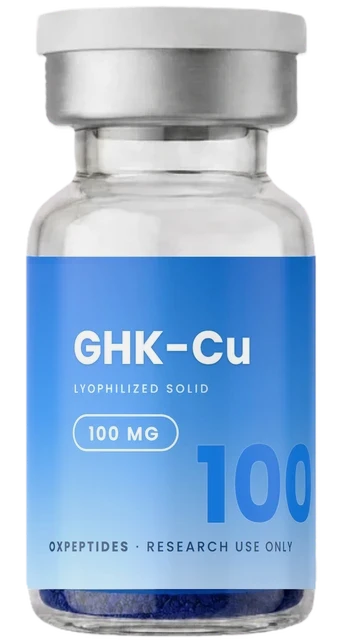
The catalog offers both as lyophilized powders in sealed 3 mL borosilicate vials with a bromobutyl septum and crimp cap:
| GHK‑Cu | AHK‑Cu | |
|---|---|---|
| Sizes | 100 mg, 200 mg, 300 mg | 50 mg, 100 mg, 150 mg |
| Also present in | GLOW (50 mg) and KLOW (50 mg) blends | Sold alone only |
| Ships to | US, Canada, UK, Australia, Europe | US, Canada, UK, Australia, Europe |
| Storage | −20 °C, sealed, away from light, moisture, oxygen | Same |
GHK‑Cu comes in larger vials because it is produced at industrial scale and costs less per milligram to make; AHK‑Cu is a smaller-volume synthesis and starts at 50 mg.
The live prices, per vial and per milligram, are on the two product pages, and the buying-side questions (supplier checks, what the price includes) are in the GHK‑Cu buying guide and the AHK‑Cu buying guide.
Which one a listing is really selling
"Copper peptide" on a marketplace can mean either compound, a mixture of the two, the copper-free tripeptide, or a cream containing a fraction of a percent of one of them. Four questions settle it:
- Is the sequence written out? Gly-His-Lys or Ala-His-Lys. "Copper peptide" alone is a category, not a compound.
- Is the mass on the certificate the right one? 340.4 for GHK, 354.4 for AHK, on a report from a named laboratory that can be looked up.
- Is the powder blue-violet, and is the quantity stated in milligrams? A white powder is not a copper complex; a listing in fluid ounces is a cosmetic.
- Does the page describe the reagent only? Composition, purity documentation, storage, "research use only". A page that describes anything else is a page that can be taken down with an order in transit.
The full seven-point method is in how to check a peptide supplier.
Published research
The publications a researcher will find when looking this compound up, with their DOI. They characterize the molecule and the models it was studied in; they are listed as references, not as claims about this product.
Pickart L, Margolina A (2018). International Journal of Molecular Sciences, 19(7), 1987.
The review most cited for GHK-Cu: the chemistry of the copper complex, its isolation in 1973, and the gene-expression datasets obtained in cell models.
Shin H, et al. (2019). Experimental Dermatology, 28(10), 1160-1166.
One of the few primary papers that studies AHK-Cu by name, side by side with GHK-Cu, in a cultured-cell model.
FAQ
What is the difference between GHK‑Cu and AHK‑Cu?
What are the molecular weights of GHK‑Cu and AHK‑Cu?
How do I tell GHK‑Cu and AHK‑Cu apart?
Why does GHK‑Cu come in larger vials than AHK‑Cu?
Which one has more published research?
Is either copper tripeptide in a blend?
Related guides
GHK‑Cu — buying guide
Composition, the blue-violet powder, vial sizes, what a batch COA must show, storage.
Read Buying guideAHK‑Cu — buying guide
The second copper tripeptide: sequence, mass, vial sizes, batch COA, and how it compares with GHK‑Cu.
Read Quality & storagePurity: what "99 %" HPLC means
What the HPLC measures, why 99 % is not 99 mg in a 100 mg vial, why a percentage needs a chromatogram.
ReadNext step
GHK‑Cu in the OXpeptides catalog
Sizes, price per vial, the batch COA and current availability are on the product page.
See GHK‑Cu in the catalogResearch use only. Not for human or veterinary use.