Glutathione peptide: structure, molecular data, certificate of analysis, 750 mg vial
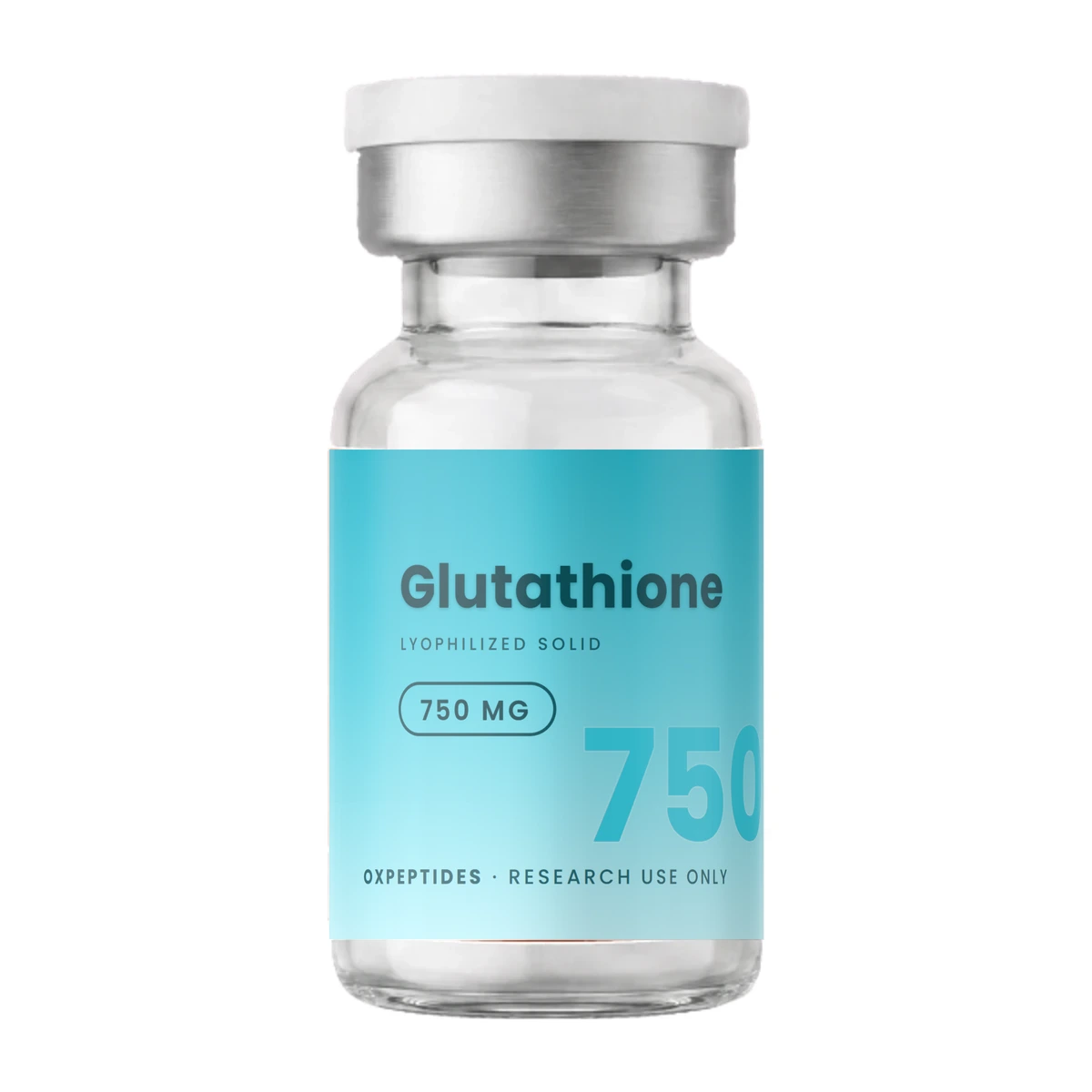
In the catalog
Glutathione
from $60
Purity >99% by HPLC — measured value on each lot's COA
| Size | Price | Per mg |
|---|---|---|
| 750 mg | $60 | $0.080/mg |
Research use only. Not for human or veterinary use. Availability is on the product page.
Glutathione (GSH) is the tripeptide gamma-L-glutamyl-L-cysteinyl-glycine, molecular formula C10H17N3O6S, 307.3 g/mol, CAS 70-18-8, in which glutamic acid is linked through its side-chain carboxyl rather than its alpha-carboxyl. It is supplied as a white crystalline powder in a sealed 750 mg vial, in the reduced (free thiol) form, with a batch certificate of analysis stating identity, purity and thiol content. Research use only. Not for human or veterinary use.
What glutathione is, and why it is only half a peptide
Glutathione, abbreviated GSH, is a tripeptide of glutamic acid, cysteine and glycine.
It was isolated from yeast by Hopkins in 1921 and its structure was settled by chemical synthesis in 1935.
It is by a wide margin the most documented small thiol in biochemistry, which is why the search volume on its name dwarfs every synthetic peptide in the catalog.
The reason it is described here as "half a peptide" is the first bond. In an ordinary peptide, each residue is joined through its alpha-carboxyl.
In glutathione, the glutamic acid is joined to the cysteine through the carboxyl of its side chain, the gamma-carboxyl, which leaves the alpha-carboxyl free.
The full name is therefore gamma-L-glutamyl-L-cysteinyl-glycine, and the "gamma" is not decoration: it is the bond that ordinary peptidases do not cut and that a mass spectrometer recognises by a characteristic loss of 129 daltons.
The second point that separates it from the rest of the catalog is scale. KPV, DSIP or SS-31 are made by solid-phase synthesis and sold by the milligram.
Glutathione at the 750 mg scale is, industrially, a crystalline reagent obtained by fermentation and crystallisation rather than by synthesis, and its certificate reads accordingly.
Research use only. Not for human or veterinary use.
Chemical data
| Property | Value |
|---|---|
| Name | gamma-L-glutamyl-L-cysteinyl-glycine (reduced glutathione, GSH) |
| Residues | 3 (Glu, Cys, Gly), gamma bond between Glu and Cys |
| Molecular formula | C10H17N3O6S |
| Molecular mass | 307.3 g/mol |
| CAS number | 70-18-8 |
| Oxidized form (GSSG) | C20H32N6O12S2, 612.6 g/mol, CAS 27025-41-8 |
| Appearance | White crystalline powder |
| Supplied as | Free acid (no counter-ion), sealed borosilicate vial |
| Solubility | Freely soluble in water; a 1 % solution is acidic (pH near 3) |
Two features of the molecule carry the whole certificate.
The thiol of the cysteine is the group that oxidizes in air: two molecules of GSH join through a disulfide to give the dimer GSSG, twice the mass minus two hydrogens.
A vial labeled "reduced glutathione" is a vial in which that thiol is still free, and the certificate has to prove it.
The two carboxyls (the free alpha-carboxyl of glutamic acid and the C-terminal carboxyl of glycine) make the compound acidic and water-soluble, and make the crystalline powder a zwitterion rather than a salt.
There is no aromatic residue in the chain. At 280 nm the compound is invisible; a chromatogram of glutathione is run at 210 to 215 nm, on the peptide bond itself.
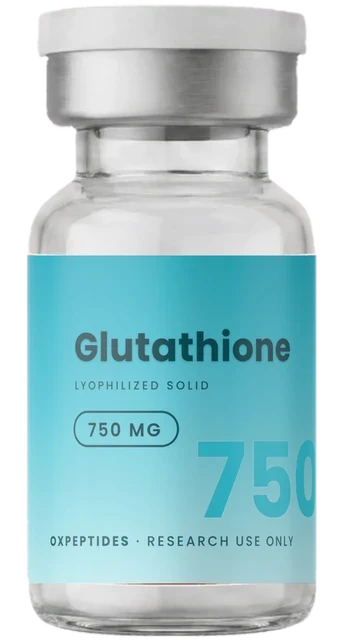
Reduced or oxidized: the one question the label must answer
Every glutathione listing states one of two things, and they are different reagents.
- Reduced glutathione (GSH), 307.3 g/mol, one free thiol per molecule. This is what the catalog holds, and what the abbreviation GSH designates on its own.
- Oxidized glutathione (GSSG), 612.6 g/mol, two GSH joined by a disulfide bridge, no free thiol. A different CAS number, a different mass, a different certificate.
The thiol is what makes the distinction fragile. GSH in the solid state, sealed and dry, stays reduced for years.
GSH in solution, exposed to air at neutral pH, oxidizes to GSSG over hours to days, faster in the presence of trace metals.
This is why the compound is sold as a dry powder, why the vial is sealed, and why a thiol-content line belongs on the certificate: a powder that has taken up moisture and started to oxidize still looks white and still weighs 750 mg.
The thiol content is measured with the Ellman reagent (DTNB): one free thiol releases one yellow anion read at 412 nm.
On a fresh lot of reduced glutathione the figure sits at 98 % or above of the theoretical value. A figure of 90 % means a tenth of the powder is already dimer.
What a glutathione certificate of analysis states
Because glutathione at this scale is a crystalline reagent and not a lyophilized synthetic peptide, its certificate has a different shape from the certificates of the rest of the catalog. Six lines carry it.
- Identity by mass spectrometry. The protonated molecule at m/z 308.1 [M+H]+, often with the sodium adduct at 330.1. On fragmentation the characteristic neutral loss of 129 daltons (the pyroglutamyl group) gives a fragment at 179.0: that loss is the signature of the gamma bond, and a molecule without it is not glutathione.
- Purity by reverse-phase HPLC at 210 to 215 nm. The compound is very polar and elutes early, in a mobile phase with little organic solvent. The impurity to look for is GSSG, which elutes later; a figure above 98 % is ordinary.
- Thiol content by the Ellman method, discussed above, stated against theory.
- Water content by Karl Fischer titration. A crystalline powder that is not a salt has no counter-ion to account for, so water is the one thing between the label mass and the compound mass; below 0.5 % is typical of a dry lot.
- Chirality. The two chiral residues are L-glutamic acid and L-cysteine; a specific optical rotation on the certificate confirms the L,L compound.
- Lot number, date, laboratory name, and a photograph of the labeled vial. The lines that tie the document to the object in hand.
There is no net peptide content line on a glutathione certificate, and its absence is correct: net peptide content exists to account for the acetate and water of a lyophilized salt, and this compound is neither.
A certificate that prints one has been copied from another product.
How to read each field, and how to check a report number against the laboratory itself, is in how to read a peptide COA and how to read a Janoshik test report. Certificates are published per lot in the COA library.
Size: what the catalog offers
Glutathione is listed in one size, a 750 mg vial.
The scale is set by the molecule: at 307 g/mol, 750 mg is 2.4 millimoles, the quantity that makes a stock solution of ordinary concentration without weighing out a fraction of a milligram, and the price per gram of a fermentation product makes a 10 mg vial pointless.
The catalog card at the top of this page reads the live figures from the catalog, so it never contradicts the product page.
Glutathione is a reagent that the catalog stocks in occasional lots rather than continuously: between lots the glutathione product page shows the size as temporarily unavailable, and a line to support@oxpeptides.com is answered with the date of the next certified lot.
No price is promised here for that reason; the product page carries the live figure.
The other non-peptide research compounds of the catalog are NAD+ (500 mg and 1 g vials, the same order of scale) and the two mitochondrial reagents MOTS‑c and SS-31.
What the price includes at OXpeptides: a sealed, labeled vial from a tested lot, its batch COA, and a replacement if the parcel arrives lost or damaged.
Ships from France (EU) and California (US) · tracked, tracked: $19, free from $150.
Storage of the sealed vial
- Temperature: −20 °C for long-term storage; 2 to 8 °C for periods of a few weeks. The dry crystalline powder is far more robust than a lyophilized synthetic peptide.
- Air and moisture: the thiol is the fragile part. Keep the vial sealed and in its box; let a cold vial reach room temperature before it leaves its bag, so no condensation forms on the glass. Once opened, reseal under dry conditions and close the vial promptly.
- Shelf life: 24 months for a sealed vial stored as above; the date printed on the label governs.
- In solution: this is where the compound is lost. An aqueous solution at neutral pH oxidizes to GSSG within hours to days in air; a solution is made at the moment it is needed, kept cold, kept acidic where the method allows, and not stored. A solution that has stood for a week is a solution of GSSG.
Ambient shipping over a few days does not degrade the sealed powder.
The rules compound by compound are in lyophilized peptides: storage and shelf life; the mass-to-volume arithmetic for a stock solution is on the bacteriostatic water calculator.
How to check a glutathione listing
"Glutathione" returns a quarter of a million searches a month in the US, and the first pages are encyclopaedia entries, retail pages for products that have nothing to do with a research reagent, and journal abstracts.
For a laboratory that needs the crystalline compound, the listing worth reading answers five questions on the page itself.
- Is the form stated? Reduced (GSH, 307.3) or oxidized (GSSG, 612.6). A page that writes "glutathione" and never says which is describing a bottle it has not looked at.
- Is the mass 307.3 and the CAS 70-18-8? Any other pair is a different compound or a copied data sheet.
- Is there a thiol-content line on the certificate? It is the one figure that distinguishes a fresh lot of the reduced form from a lot that has started to oxidize on the shelf.
- Is the certificate from a named independent laboratory, with a lot number matching the vial, a date, and a photograph of the labeled vial?
- Does the page describe the reagent only (structure, mass, purity documentation, storage), with research use only stated plainly? A supplier who publishes usage content is a supplier easy to shut down, and the parcel in transit belongs to the buyer.
The seven-point method, including what a re-used or edited certificate looks like, is in how to check a peptide supplier. The US-wide checklist is in where to buy research peptides in the US.
Published research
The publications a researcher will find when looking this compound up, with their DOI. They characterize the molecule and the models it was studied in; they are listed as references, not as claims about this product.
Hopkins FG (1921). Biochemical Journal, 15(2), 286-305.
The paper that isolated the compound from yeast and named it glutathione, a century before the vial in the catalog.
Harington CR, Mead TH (1935). Biochemical Journal, 29(7), 1602-1611.
The chemical synthesis that settled the structure: the glutamyl residue is joined through its gamma-carboxyl, not its alpha-carboxyl.
Meister A, Anderson ME (1983). Annual Review of Biochemistry, 52, 711-760.
doi:10.1146/annurev.bi.52.070183.003431
The reference review of the chemistry of the tripeptide: the gamma bond, the thiol, the oxidized dimer and the enzymes that make and consume it.
Ellman GL (1959). Archives of Biochemistry and Biophysics, 82(1), 70-77.
doi:10.1016/0003-9861(59)90090-6
The reagent (DTNB) behind the thiol-content line of every glutathione certificate: one free thiol gives one yellow anion read at 412 nm.
FAQ
Is glutathione a peptide?
What is the molecular weight of glutathione?
What size does the glutathione vial come in?
What should a glutathione certificate of analysis show?
How is glutathione stored?
Related guides
NAD+ — buying guide
A coenzyme, not a peptide: structure, mass, the white powder, vial sizes, what a batch COA must show.
Read Buying guideSS-31 (elamipretide): sequence, COA
The Szeto-Schiller tetrapeptide: two unnatural residues, mass 639.8, what a COA must show, the 10 mg vial.
Read Quality & storageHow to read a peptide COA
What each field must say, how to verify it on the laboratory site, the signs of an edited certificate.
ReadNext step
Glutathione in the OXpeptides catalog
Sizes, price per vial, the batch COA and current availability are on the product page.
See Glutathione in the catalogResearch use only. Not for human or veterinary use.