ARA-290 (cibinetide) peptide: sequence, molecular data, certificate of analysis, 10 mg vial
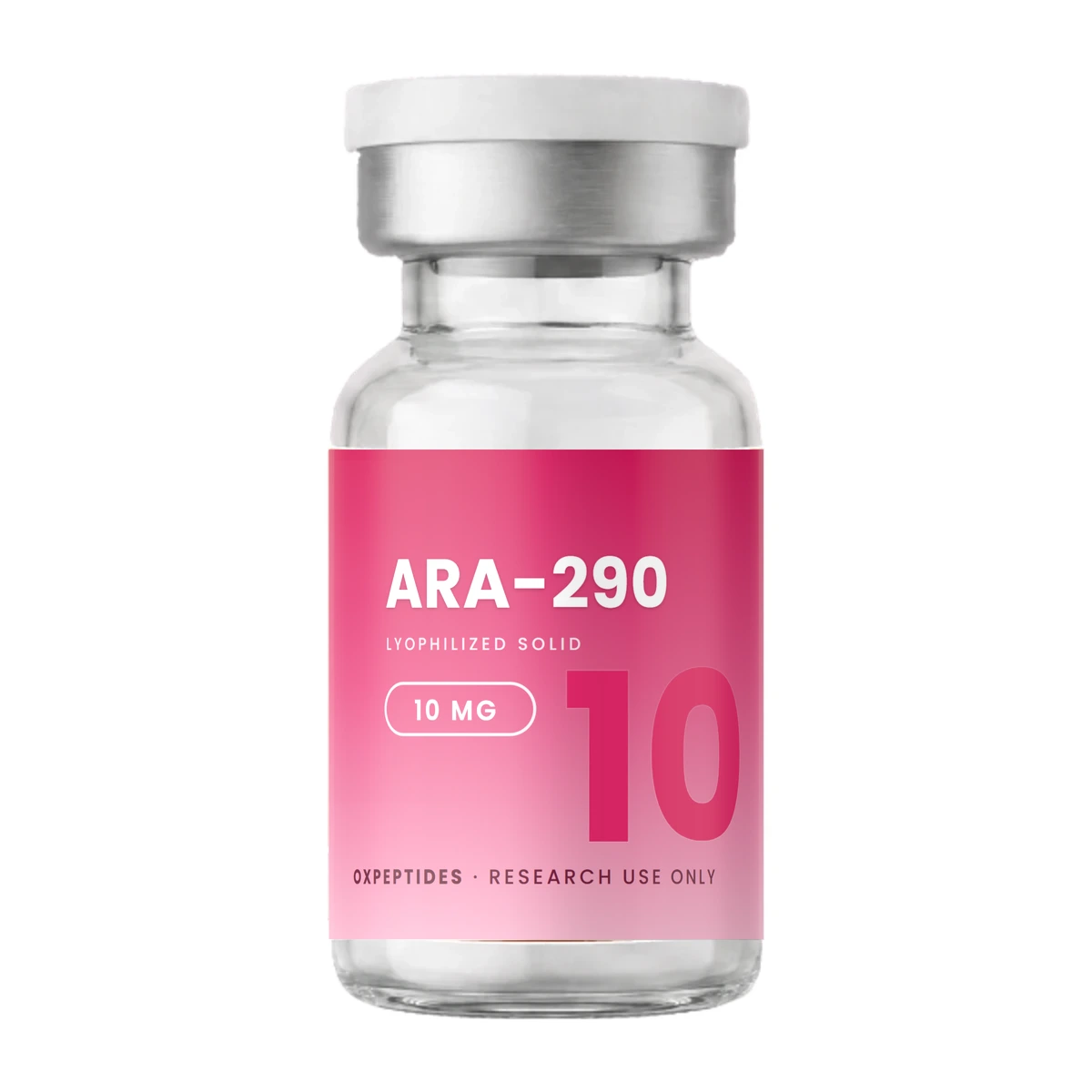
In the catalog
ARA-290
from $105
Purity >99% by HPLC — measured value on each lot's COA
| Size | Price | Per mg |
|---|---|---|
| 10 mg | $105 | $10.50/mg |
Research use only. Not for human or veterinary use. Availability is on the product page.
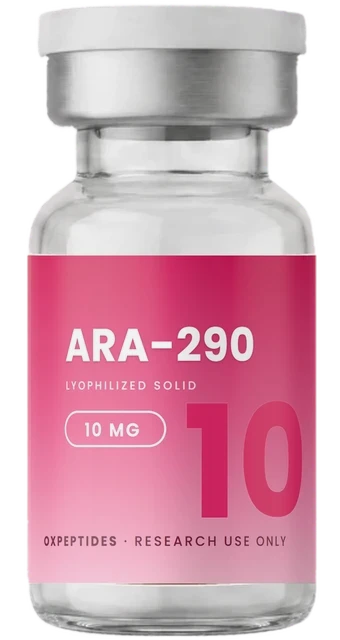
ARA-290 is the synthetic linear peptide pGlu-Glu-Gln-Leu-Glu-Arg-Ala-Leu-Asn-Ser-Ser, eleven residues, molecular formula C51H84N16O21, 1,257.3 g/mol, CAS 1208243-50-8, designed in 2008 from the solvent-exposed face of helix B of erythropoietin; cibinetide is its international name and pHBSP its laboratory name. It is supplied as a white lyophilized powder in a sealed 10 mg vial, with a batch certificate of analysis stating identity and purity. Research use only. Not for human or veterinary use.
What ARA-290 designates, and its three names
ARA-290 is a synthetic peptide of eleven residues.
It was designed in 2008 by Michael Brines, Anthony Cerami and colleagues, who took the residues that face the solvent on one helix of the protein erythropoietin (helix B, residues 58 to 82 of the mature protein) and strung them into a short linear chain, in the order in which they sit on that face rather than in the order of the parent sequence.
The laboratory name was pHBSP, for pyroglutamate helix B surface peptide; the company code became ARA-290; the international non-proprietary name is cibinetide. Three names, one molecule.
What matters for a data sheet is what the peptide is not.
It is not erythropoietin and not a fragment of it: erythropoietin is a glycoprotein of about 165 residues and roughly 30,000 g/mol, and this is an eleven-residue synthetic chain of 1,257 g/mol with no sugar on it.
In the assays of the 2008 paper the peptide does not bind the homodimeric erythropoietin receptor, which is the point of the design. Nothing on this page concerns the protein it was modelled on. Research use only.
Not for human or veterinary use.
Chemical data
| Property | Value |
|---|---|
| Sequence (three-letter) | pGlu-Glu-Gln-Leu-Glu-Arg-Ala-Leu-Asn-Ser-Ser |
| Sequence (one-letter) | pE-EQLERALNSS (pyroglutamyl at position 1) |
| Residues | 11, linear, C-terminal free acid |
| Molecular formula | C51H84N16O21 |
| Molecular mass | 1,257.3 g/mol average; 1,256.6 monoisotopic |
| CAS number | 1208243-50-8 |
| Charge at neutral pH | −3 (four carboxyls, one arginine, no free N-terminus) |
| Aromatic residues | None: no signal at 280 nm |
| Cysteine | None: no disulfide |
| Appearance | White to off-white lyophilized powder |
| Supplied as | Acetate salt or free acid (the certificate states which), sealed borosilicate vial |
| Solubility | Water, and aqueous buffers |
Three glutamic acids and a C-terminal carboxyl against a single arginine make the chain strongly acidic.
It dissolves in plain water, it elutes early on a reverse-phase column, and it ionises readily in negative mode on a mass spectrometer, which is unusual among the catalog peptides and useful on a certificate.
The residue at position one is the one that needs explaining.
The pyroglutamate: a peptide with no N-terminus
An ordinary peptide starts with a free amine. ARA-290 does not.
Its first residue is a glutamic acid whose side-chain carboxyl has condensed with its own alpha-amine to close a five-membered ring: pyroglutamic acid, written pGlu or pE.
The ring is formed deliberately during synthesis (a glutamic acid at the N-terminus closes into it with a loss of water, a glutamine with a loss of ammonia), and once formed there is no free amine left at the start of the chain.
Three consequences follow for the certificate and the bench.
- The mass. The cyclisation removes one molecule of water. The ring-closed peptide reconstructs to 1,257.3; the open form, with a free glutamic acid at position one, is 18 daltons heavier at 1,275.3 (17 heavier if the residue stayed a glutamine). A certificate that reconstructs to 1,275 describes a peptide whose ring never closed, which is a different molecule.
- The chemistry. With no free amine, the chain gives no colour with ninhydrin, cannot be sequenced by Edman degradation from its N-terminus, and is not a substrate for aminopeptidases. Identity is established by mass spectrometry and by fragmentation, not by a sequencer.
- The counter-ion. With the N-terminus closed, the only basic site in the molecule is the arginine. An acetate salt of this peptide carries one acetate per molecule, 60 g against 1,257, so the net peptide content of a pure lyophilized lot can reach 95 %; 85 to 92 % after residual water is the realistic band. Some suppliers list the peptide as a free acid or a sodium salt; the certificate states which.
What an ARA-290 certificate of analysis states
Four lines carry the document for an eleven-residue linear peptide.
- Purity by reverse-phase HPLC, read at 210 to 215 nm; there is no tryptophan, tyrosine or phenylalanine in the chain, so a 280 nm trace shows nothing. One main peak, its area against total peak area, above 98 % for a catalog lot. The by-products to expect are the open-ring form described above (eluting slightly earlier), a deamidated chain in which the glutamine or the asparagine has become an acid (one dalton heavier, eluting slightly later), and the deletion sequences of an eleven-residue synthesis: a missing serine at 87 daltons lower, a missing leucine at 113 lower.
- Mass by mass spectrometry. The protonated molecule near m/z 1,257.6 [M+H]+ and the doubly charged ion near 629.3 [M+2H]2+, both reconstructing to 1,256.6 monoisotopic; in negative mode, the deprotonated molecule near 1,255.6. A value 18 higher is the open ring.
- Net peptide content, by amino-acid analysis or nitrogen determination, and the salt form. A 10 mg fill of the acetate salt holds roughly 8.5 to 9.2 mg of peptide; the arithmetic is set out on the bacteriostatic water calculator.
- Lot number, date, laboratory name, and a photograph of the labeled vial. The four fields that tie the document to the object in hand rather than to a production run somewhere.
How to read each field, and how to check a report number against the laboratory itself, is in how to read a peptide COA and how to read a Janoshik test report. Certificates are published per lot in the COA library.
Size: what the catalog offers
ARA-290 is listed in one size, a 10 mg vial: 10 mg of a 1,257-dalton peptide is 8.0 micromoles, the bench quantity for an eleven-residue compound.
The catalog card at the top of this page reads the live figures from the catalog, so it never contradicts the product page.
ARA-290 is stocked in occasional certified lots rather than continuously: between lots the ARA-290 product page shows the size as temporarily unavailable, and a line to support@oxpeptides.com is answered with the date of the next lot.
No price is promised here for that reason; the product page carries the live figure. The references it is listed alongside in the catalog are BPC‑157, TB‑500 and KPV, three other linear peptides with no disulfide.
What the price includes at OXpeptides: a sealed, labeled vial from a tested lot, its batch COA, and a replacement if the parcel arrives lost or damaged.
Ships from France (EU) and California (US) · tracked, tracked: $19, free from $150.
Storage of the sealed vial
- Temperature: −20 °C for long-term storage; 2 to 8 °C for periods of a few weeks.
- Light and moisture: keep the vial sealed and in its box. Let a cold vial reach room temperature before it leaves its bag, so no condensation forms on the glass and none of it reaches the powder. An acidic peptide with four carboxyls is hygroscopic.
- Shelf life: 24 months for a sealed lyophilized vial stored as above; the date printed on the label governs.
- In solution: refrigerated, protected from light, and split into aliquots at the moment it is made. The pyroglutamate makes the N-terminus stable; the asparagine and glutamine are the residues that deamidate slowly in water at neutral pH, so a solution is not kept for weeks.
Ambient shipping over a few days does not degrade a sealed lyophilized powder, which is why research peptides travel without cold packs. Compound by compound, the rules are in lyophilized peptides: storage and shelf life.
How to check an ARA-290 listing
"ARA-290" returns a few thousand searches a month in the US, and the first page is journal abstracts, encyclopaedia entries and a handful of research suppliers. The listing worth reading answers five questions on the page itself.
- Is the sequence printed, with the pyroglutamate? pGlu-Glu-Gln-Leu-Glu-Arg-Ala-Leu-Asn-Ser-Ser, eleven residues. A page that writes a plain glutamic acid at position one, or gives a different residue count, is describing another molecule.
- Is the mass 1,257, and is it measured? A reconstructed 1,275 is the open-ring peptide; a page that gives no measured spectrum has nothing to check.
- Is there a batch certificate from a named independent laboratory, with a lot number matching the vial, a date, a photograph of the labeled vial, and an HPLC trace read at 210 to 215 nm rather than 280?
- Is the vial sealed, labeled and lyophilized, with a stated size and a stated salt form? A listing that sells a solution has made a choice about storage on the buyer's behalf.
- Does the page describe the reagent only (sequence, mass, purity documentation, storage), with research use only stated plainly? A supplier who publishes usage content is a supplier easy to shut down, and the parcel in transit belongs to the buyer.
The seven-point method, including what a re-used or edited certificate looks like, is in how to check a peptide supplier. The US-wide checklist is in where to buy research peptides in the US.
Published research
The publications a researcher will find when looking this compound up, with their DOI. They characterize the molecule and the models it was studied in; they are listed as references, not as claims about this product.
Brines M, Patel NSA, Villa P, Brines C, Mennini T, De Paola M, Erbayraktar Z, Erbayraktar S, Sepodes B, Thiemermann C, Ghezzi P, Yamin M, Hand CC, Xie QW, Coleman T, Cerami A (2008). Proceedings of the National Academy of Sciences, 105(31), 10925-10930.
The paper that designed the peptide: the eleven residues taken from the aqueous face of helix B of erythropoietin, the pyroglutamate at the N-terminus, and the name pHBSP.
Brines M, Cerami A (2012). Molecular Medicine, 18(3), 486-496.
The review by the two designers that collects the chemistry of the helix B peptides and the receptor complex they were characterised against in cell-free and cellular assays.
FAQ
What is ARA-290?
Are ARA-290, cibinetide and pHBSP the same thing?
What is the molecular weight of ARA-290?
What size does ARA-290 come in?
What should an ARA-290 certificate of analysis show?
How is ARA-290 stored?
Related guides
BPC‑157 — buying guide
Sequence and mass, the white lyophilized powder, vial sizes, what a batch COA must show, storage.
Read Buying guideKPV peptide: what it is, how it is supplied
The C-terminal tripeptide of α-MSH: sequence, mass, vial sizes on the market, what a COA must show.
Read Quality & storageHow to read a peptide COA
What each field must say, how to verify it on the laboratory site, the signs of an edited certificate.
ReadNext step
ARA-290 in the OXpeptides catalog
Sizes, price per vial, the batch COA and current availability are on the product page.
See ARA-290 in the catalogResearch use only. Not for human or veterinary use.