Bacteriostatic water for research: the laboratory guide (USP, 0.9 % benzyl alcohol, COA, storage)
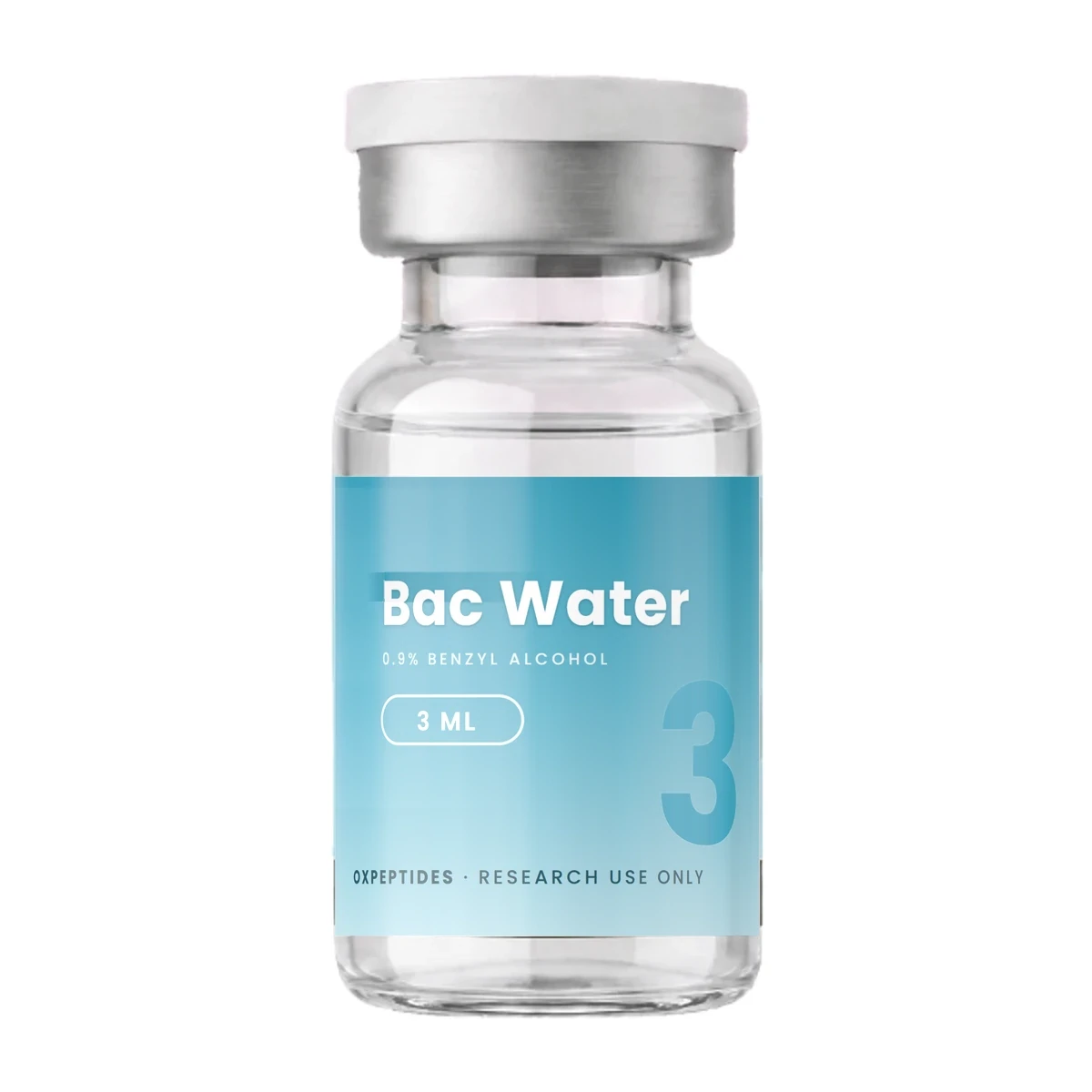
Shipped from the EU, tracked parcel, 30-day returns. Research use only. Not for human or veterinary use.
Bacteriostatic water is sterile water prepared to the United States Pharmacopeia monograph for bacteriostatic water, with 0.9 % benzyl alcohol added as a preservative so that microbes cannot multiply in an opened vial. It is supplied in sealed glass vials of 3, 10 or 30 mL and serves in laboratories as the solvent for lyophilized peptides; a research supplier lists it with a certificate for the lot, like any other reagent.
What bacteriostatic water is, by the monograph
The name comes from a monograph of the United States Pharmacopeia (USP).
The monograph defines a sterile, non-pyrogenic water to which one or more antimicrobial preservatives have been added, filled into multiple-withdrawal containers, with a pH between 4.5 and 7.0 and no added salt, buffer or sugar.
On the American market the preservative is almost always benzyl alcohol at 0.9 % (9 mg per mL), and the label says so.
Two words in the name do two different jobs. Sterile describes how the water was made: filtered, filled and sealed so that nothing lives in it at the time of filling.
Bacteriostatic describes what the preservative does afterward: it keeps bacteria from multiplying once the septum has been pierced and the vial is open to the air.
The preservative does not sterilize a contaminated liquid; it holds an already sterile one.
In a research setting this water is the standard solvent for the lyophilized peptides of this catalog, such as GHK-Cu, BPC-157 and TB-500.
It is described and sold here as a laboratory supply only. Research use only. Not for human or veterinary use.
What 0.9 % benzyl alcohol does, and what it does not
Benzyl alcohol (C7H8O, 108.1 g/mol) is an aromatic alcohol, a clear liquid with a faint almond-like odor, miscible with water at the concentration in question.
At 0.9 % it is bacteriostatic and, for most organisms, also fungistatic: it stops growth. That is the whole of its role.
| Benzyl alcohol 0.9 % does | Benzyl alcohol 0.9 % does not |
|---|---|
| Keep bacteria from multiplying in an opened vial | Sterilize a liquid that was contaminated |
| Allow multiple withdrawals from the same vial over 28 days | Extend the shelf life of the vial |
| Give the water a faint, characteristic odor | Change the pH range of the monograph (4.5 to 7.0) |
| Stay in solution at room temperature | Survive freezing without separating from the water |
The 28-day figure is the reason the water exists. Plain sterile water has no preservative; once its vial is opened, the USP expects it to be discarded.
A bacteriostatic vial is designed to be pierced several times over four weeks, which is why the septum is a self-sealing bromobutyl rubber and why the label carries a "discard after opening" instruction.
Plain sterile water and bacteriostatic water are compared point by point in the bacteriostatic water buying guide.
Sizes and makers: 3 mL, 10 mL, 30 mL
Three sizes cover the market, and each has its own history.
- 30 mL is the hospital-supply size, made in the United States by Hospira (a Pfizer company) and by a small number of other pharmaceutical manufacturers. "Hospira bacteriostatic water" is searched forty thousand times a month because that one product has been intermittently out of stock across the whole market for years, and because its 30 mL flint-glass vial is what most people picture when they hear the name.
- 10 mL is the traditional laboratory size: a glass vial with a rubber stopper and crimp cap, sold by laboratory-supply houses and by research-peptide suppliers.
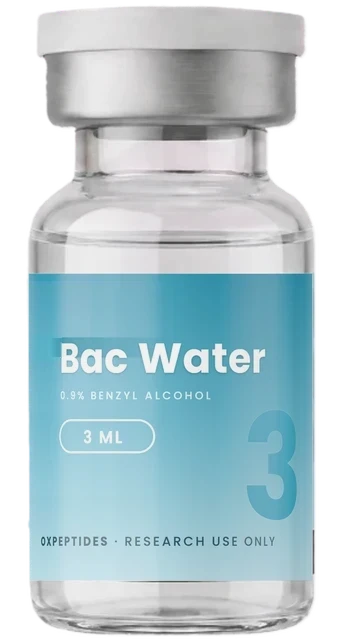
- 3 mL is the size that fits a research order: one small vial per lot, enough for the lyophilized vials it ships with, nothing left over past 28 days. It is the size listed in the OXpeptides catalog.
Whatever the size, a vial is a laboratory supply only if the label carries three things: the words "Bacteriostatic Water" and "USP", the preservative and its concentration ("0.9 % benzyl alcohol"), and the volume; the lot is traced through its certificate.
A bottle without a lot number is a bottle of water.
The glass matters too. Type I borosilicate is the standard for a multiple-withdrawal vial; it does not leach alkali into a liquid stored for two years.
The septum is bromobutyl rubber (self-sealing after a puncture, low permeability to gas) and the closure an aluminum crimp with a plastic flip-off disc that shows whether the vial has been opened.
How to read the certificate of a water lot
A certificate of analysis for bacteriostatic water is shorter than one for a peptide, and every line on it is a pass/fail test against the monograph rather than a purity percentage. A complete one shows:
| Test | What the monograph asks | What a passing lot reads |
|---|---|---|
| Sterility | No growth in the sterility test | "Complies" or "No growth" |
| Bacterial endotoxins | Below the limit set for the volume | A value in EU/mL under the limit |
| pH | 4.5 to 7.0 | A measured value in that range |
| Benzyl alcohol assay | 0.9 % nominal (label claim) | Typically 90 to 110 % of label claim |
| Particulate matter | Within the limits for small-volume containers | "Complies" |
| Appearance | Clear, colorless | "Clear, colorless liquid" |
| Lot number, date | Traceability | The lot supplied and its manufacturing date |
Three details separate a certificate from a document. First, the certificate must be the one for the lot supplied, not a generic document.
Second, the benzyl alcohol line must be an assay, a measured value, and not a copy of the label.
Third, the certificate comes from the manufacturer (water is not sent to Janoshik the way a peptide is), so the manufacturer's name on the certificate must match the manufacturer on the label.
A supplier that re-bottles water and shows another company's certificate has broken the chain.
The same reading discipline applies to peptide certificates, field by field, in how to read a peptide COA. OXpeptides publishes its analysis reports in the COA library as they come back from the laboratory.
Storage: the one reagent that stays out of the freezer
Everything else in a research order goes cold. Bacteriostatic water does not.
- Temperature: 20 to 25 °C, the controlled room temperature of the monograph, with excursions between 15 and 30 °C allowed. Never freeze it. Ice expands and can crack the vial, and benzyl alcohol separates from ice, so a thawed vial no longer has a uniform 0.9 %.
- Light: in the box. Benzyl alcohol oxidizes slowly under light to benzaldehyde, which is the source of a stronger almond odor in an old, light-exposed vial.
- Sealed shelf life: 24 months for most makers, printed on the label. The date governs, not the appearance.
- After the first puncture: 28 days, the period the preservative is qualified for. Write the date of first use on the label.
Between the freezer for the peptides and the shelf for the water, a research bench holds two storage lines. The cold line, compound by compound, is in lyophilized peptides: storage and shelf life.
What should make you discard a vial
Water is inexpensive, and a suspect vial is never worth keeping. Discard it when:
- The liquid is not clear. Cloudiness, a haze that moves when the vial is tilted, floating particles or a yellow tint all mean the lot has failed the appearance test in front of you.
- The seal is not intact. A missing flip-off disc, a lifted crimp or a septum with a visible hole on arrival means the vial was opened before you.
- The label is incomplete. No concentration of benzyl alcohol, no volume, or a hand-written label.
- The vial was frozen. A cracked vial, or a vial that arrived frozen in winter shipping, is discarded even if it looks clear once thawed.
- 28 days have passed since the first puncture, or the sealed vial is past its shelf life.
Where the catalog fits
OXpeptides lists a 3 mL sealed vial of bacteriostatic water, 0.9 % benzyl alcohol, next to every lyophilized compound, so the solvent and the powders it accompanies ship in one parcel, from one source.
The label states the concentration and the volume. It ships from our EU stock, tracked, to the European Union and Norway.
For sizes, prices and the plain-water comparison, see the bacteriostatic water buying guide. For the vial itself, see bacteriostatic water in the catalog →
FAQ
What is bacteriostatic water?
What does the 0.9 % benzyl alcohol do?
Why is Hospira bacteriostatic water searched so often?
What is on the certificate of a bacteriostatic water lot?
How is bacteriostatic water stored?
Which size does OXpeptides sell?
What is bacteriostatic water used for?
Related guides
Bacteriostatic water — buying guide
Sterile water with 0.9 % benzyl alcohol: what the label says, sizes, storage, what to check.
Read Quality & storageLyophilized peptides: storage and shelf life
What lyophilization is, the four things that degrade a peptide, storage temperature and shelf life.
Read Quality & storageHow to read a peptide COA
What each field must say, how to verify it on the laboratory site, the signs of an edited certificate.
ReadNext step
Diluent Water in the OXpeptides catalog
Sizes, price per vial, the Janoshik report (once published) and current availability are on the product page.
See Diluent Water in the catalogResearch use only. Not for human or veterinary use.