SS-31 (elamipretide) peptide: sequence, how it is supplied, COA, sizes
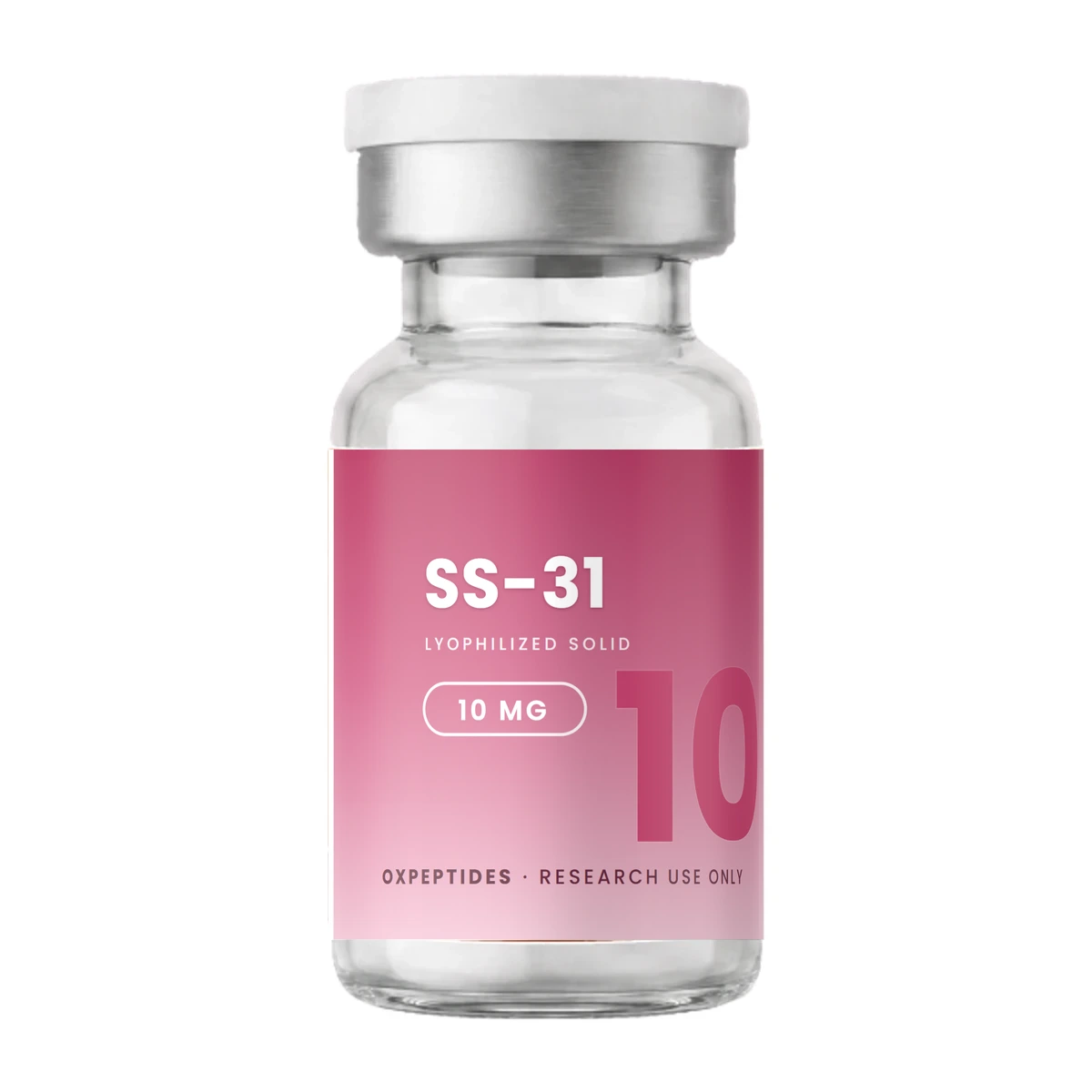
In the catalog
SS-31
from $93.50subscription −15%, or $110 one-time
Purity >99% by HPLC — measured value on each lot's COA
| Size | Subscription | One-time | Per mg |
|---|---|---|---|
| 10 mg | $93.50 | $110 | $9.35/mg |
Research use only. Not for human or veterinary use. Availability is on the product page.
SS-31 is the synthetic tetrapeptide D-Arg-2′,6′-dimethyltyrosine-Lys-Phe-NH2, 639.8 g/mol, one of the Szeto-Schiller peptides first described in the 2000s; MTP-131 and elamipretide are later names for the same molecule. It is supplied as a white lyophilized powder in a sealed 10 mg vial, with a batch certificate of analysis (HPLC purity, mass spectrometry identity at m/z 640.4). Research use only.
What SS-31 is
SS-31 is a synthetic peptide of four residues.
The initials stand for Szeto and Schiller, the two chemists who designed a series of short, positively charged, aromatic peptides in the early 2000s; the number is the position of this one in the series.
The same molecule was later coded MTP-131 and given the international name elamipretide. Three names, one sequence.
| Property | Value |
|---|---|
| Sequence | D-Arg-Dmt-Lys-Phe-NH2 |
| Dmt | 2′,6′-dimethyltyrosine, a tyrosine with two extra methyl groups on the ring |
| Length | 4 residues, C-terminal amide |
| Formula | C32H49N9O5 |
| Mass (free peptide) | 639.8 g/mol |
| Charge at neutral pH | +3 (arginine, lysine, N-terminus) |
| Salt form supplied | acetate (some lots trifluoroacetate; the certificate states which) |
| Appearance | white lyophilized powder |
The design alternates basic and aromatic residues (basic-aromatic-basic-aromatic), which is what lets the short chain bind cardiolipin, a lipid found in the inner mitochondrial membrane, in the cell-free experiments described in the publications below.
The same sequence was licensed in 2025 under a trade name for one rare indication; what is sold as SS-31 for research is the identical tetrapeptide, made by solid-phase synthesis, purified by preparative HPLC and freeze-dried.
Research use only. Not for human or veterinary use.
Two residues that do not occur in proteins
Of the four residues, two are not among the twenty amino acids of proteins, and both change how the peptide is made and certified.
D-arginine at position 1 is the mirror image of the natural L-arginine. It is there so that the peptide is not cleaved by aminopeptidases, which recognize only L-residues.
On a certificate it is invisible to HPLC and mass spectrometry (an enantiomer has the same mass and, on an ordinary column, the same retention time); only a chiral analysis or the synthesis record confirms it.
A supplier that buys the D-Arg building block from a named vendor and states it on the certificate has answered the question; one that does not has left it open.
2′,6′-dimethyltyrosine (Dmt) at position 2 is a tyrosine with two methyl groups added to the aromatic ring.
It is a costly building block, roughly a hundred times the price of tyrosine per gram, and the single largest item in the cost of the peptide.
Its presence is confirmed by mass: the two methyls add 28.0 daltons, so a "SS-31" whose mass reconstructs to 611.8 instead of 639.8 was made with plain tyrosine and is a different molecule.
Reading the SS-31 certificate of analysis
HPLC purity: one main peak
On reverse-phase HPLC the tetrapeptide elutes as a single sharp peak; the purity figure is the area of that peak against all peaks. Above 99 % is the specification for the catalog lots.
With only four residues, the deletion sequences that plague longer peptides are few; the impurities to look for are the des-methyl variant (tyrosine in place of Dmt, eluting slightly earlier) and the free acid (C-terminal OH instead of NH2, +1 dalton, eluting later).
Mass spectrometry: 640.4 and 320.7
A 640-dalton peptide with three basic sites is seen by electrospray ionization as the singly charged ion at m/z 640.4 [M+H]+ and the doubly charged ion at 320.7 [M+2H]2+.
Both reconstruct to 639.8. A reconstructed 611.8 is the des-methyl peptide; 640.8 is the free acid.
Net peptide content, counter-ion, water
A peptide with three basic sites carries three counter-ions, and for a molecule this small they weigh a lot: as the triacetate, 639.8 g of peptide comes with 180.2 g of acetate, so the net peptide content of a pure lyophilized acetate salt cannot exceed 78 %, and 70 to 75 % after residual water is the realistic figure.
A certificate that reports 95 % net content for an SS-31 acetate salt has measured something else.
If the salt is the trifluoroacetate (from an HPLC purification that was not exchanged), the counter-ions weigh 342 g and the ceiling falls to 65 %; the certificate must state the salt.
What else must be on the page
- The laboratory's name and a verifiable test number (Janoshik Analytical is the reference in this market).
- The lot number, identical to the one on the vial.
- The test date and a photograph of the tested vial wearing the supplier's label.
The OXpeptides certificates are published per lot in the COA library and on the SS-31 product page. The field-by-field method is in how to read a peptide COA.
Sizes and price: what the catalog offers
SS-31 is stocked in one size, 10 mg: 10 mg of a 640-dalton peptide is 15.6 micromoles, a quantity that suits the bench, and the Dmt building block makes smaller fills uneconomical per milligram.
It is listed with the two other mitochondrial reagents the same laboratories order, MOTS‑c (the 16-residue mitochondrial-derived peptide) and NAD+.
The catalog card at the top of this page reads the live price; volume tiers apply from two vials, and the subscription price applies to every delivery.
What the price includes at OXpeptides: a sealed, labeled vial from a tested lot, its batch COA, and a replacement if the parcel arrives lost or damaged.
Ships from France (EU) and California (US) · tracked, tracked: $19, free from $150.
Storage of the sealed vial
- Temperature: −20 °C for long-term storage; a refrigerator (2 to 8 °C) for a few weeks.
- Light: the dimethyltyrosine ring is a phenol, and phenols oxidize slowly in light and air; keep the vial in its box.
- Moisture: a salt with three counter-ions is hygroscopic. Keep it sealed; let a cold vial reach room temperature before it leaves its bag.
- Shelf life: 24 months for a sealed lyophilized vial stored cold; the date on the label governs. In solution the peptide is stable for days at 4 °C, which is unusual among short peptides and is due to the D-residue and the amide terminus.
A few days of ambient shipping do not degrade the sealed powder. The rules compound by compound are in lyophilized peptides: storage and shelf life.
How to check an SS-31 listing
"SS-31 peptide" returns journal articles, videos and forum threads before it returns a research supplier. For a laboratory that needs the reagent, the listing that matters answers five questions on the page itself.
- Is the mass 639.8? A certificate reconstructing to 611.8 is the des-methyl peptide; the Dmt residue is the whole cost of the molecule and the first thing a cheap lot leaves out.
- Is the salt stated, with a net content that is arithmetically possible (below 78 % for the acetate, below 65 % for the trifluoroacetate)?
- Is the COA from a named independent laboratory, verifiable on the lab's site, showing the supplier's labeled vial with the lot number you receive?
- Does the vial ship from domestic stock, tracked, in a few days? The catalog ships from California to the US and from France to Europe.
- Does the page describe the reagent only (sequence, purity documentation, storage), with "research use only" stated plainly?
The seven-point method is in how to check a peptide supplier; the US-wide checklist in where to buy research peptides in the US.
Published research
The publications a researcher will find when looking this compound up, with their DOI. They characterize the molecule and the models it was studied in; they are listed as references, not as claims about this product.
Szeto HH (2014). British Journal of Pharmacology.
The review by the peptide's co-inventor: the Szeto-Schiller series, the sequence, the role of the dimethyltyrosine residue and the binding to cardiolipin in vitro.
Birk AV, Liu S, Soong Y, Mills W, Singh P, Warren JD, Seshan SV, Pardee JD, Szeto HH (2013). Journal of the American Society of Nephrology.
The biophysical characterization of the peptide-cardiolipin interaction in isolated mitochondria and model membranes.
FAQ
What is SS-31?
Are SS-31 and elamipretide the same thing?
What mass should an SS-31 COA show?
Why is the net peptide content of SS-31 lower than for other peptides?
What sizes does SS-31 come in?
How is SS-31 stored?
Related guides
MOTS‑c — buying guide
The 16-residue mitochondrial peptide: sequence, mass, vial sizes, what a batch COA must show.
Read Buying guideThymosin alpha-1: sequence, COA
The 28-residue N-acetylated thymic peptide: mass 3,108.3, not TB‑500, not thymalin, the 10 mg vial, the COA.
Read Quality & storageHow to read a peptide COA
What each field must say, how to verify it on the laboratory site, the signs of an edited certificate.
ReadNext step
SS-31 in the OXpeptides catalog
Sizes, price per vial, the batch COA and current availability are on the product page.
See SS-31 in the catalogResearch use only. Not for human or veterinary use.