NAD+ (nicotinamide adenine dinucleotide): what it is, how it is supplied, and how to choose a research supplier
NAD+ (nicotinamide adenine dinucleotide, about 663 Da) is a coenzyme, not a peptide, supplied for laboratory research as a white lyophilized powder in sealed glass vials of 500 mg or 1 g. Research-grade NAD+ is bought from a supplier that publishes a batch-specific certificate of analysis (HPLC purity and mass confirmation) from an independent laboratory, ships domestically, stores it away from light and heat, and sells it strictly as a reagent.
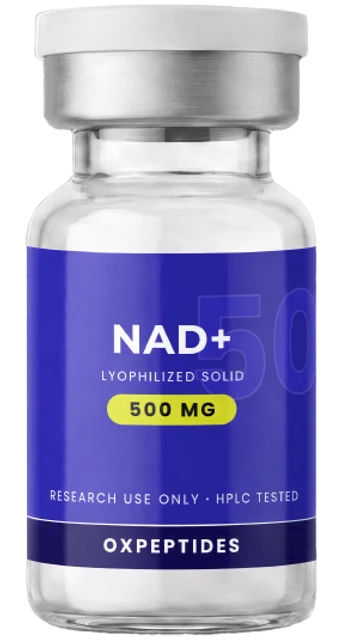
In the catalog
NAD+
| Size | Price | Per unit |
|---|---|---|
| 500 mg | $42 | $0.08 / mg |
| 1000 mg | $68 | $0.07 / mg |
Research use only. Not for human or veterinary use. One email when the first batch is listed. No newsletter.
What NAD+ is — and why it is not a peptide
NAD+ is nicotinamide adenine dinucleotide in its oxidized form: two nucleotides — one carrying nicotinamide, the other adenine — joined through their phosphate groups. Its molecular weight is about 663 Da. It is a coenzyme present in every living cell, where it shuttles electrons in redox reactions and serves as a substrate for several enzyme families (sirtuins, PARPs, CD38).
It is not a peptide. There are no amino acids in it and no peptide bond. The search phrase "NAD+ peptide" exists because NAD+ is sold by the same research suppliers, in the same vials, next to peptides — not because of its chemistry. A listing that calls it a peptide has not read its own label.
Three details identify the reagent on a bench:
- The mass. Mass spectrometry on the COA confirms a peak near 663 Da (or the corresponding ion), not a peptide mass.
- The form. Free acid or a sodium salt; both are white to off-white lyophilized powders. The COA states which one was tested.
- The quantity. Sold by the hundreds of milligrams, not by the ten: 500 mg and 1 g are the catalog sizes.
In the catalog, NAD+ is a research reagent: a sealed vial of lyophilized powder with a lot number and a certificate of analysis. Research use only. Not for human or veterinary use.
"NAD+" on Google vs NAD+ as a reagent
"NAD+" is one of the largest searches in this category, and almost everything it returns is either a clinic or a consumer product built on a precursor (nicotinamide riboside, NMN) — neither of which is NAD+ itself. The reagent is a different object with properties that can be checked.
| What to check | Consumer / clinic listing | Research reagent |
|---|---|---|
| Compound | Often a precursor (NR, NMN), not NAD+ | NAD+ itself, mass confirmed at ~663 Da |
| Form | Tablet, liquid blend, "per serving" | Lyophilized powder, single compound, net mg on the label |
| Purity documentation | None, or "pharmaceutical grade" as text | HPLC chromatogram with a measured percentage |
| Lot traceability | None | Lot number on the vial, same lot on the COA |
| Container | Bottle or pouch | Sealed glass vial, septum, crimp cap, printed label |
| Storage on arrival | Shelf | Freezer, protected from light, moisture and heat |
A listing that does not say whether it sells NAD+ or a precursor, gives no mg quantity and no verifiable COA is not a research supply.
How NAD+ is supplied: sizes and what is in the vial
Research NAD+ comes as a white lyophilized (freeze-dried) powder in a glass vial closed with a rubber septum and an aluminum crimp cap. The label states the compound, the net quantity, the lot number and the words "research use only".
The catalog offers two sizes — 500 mg and 1,000 mg (1 g) — and the price per milligram is listed for each. The live table at the top of this page is read directly from the catalog, so the prices shown there are the prices in force today. See NAD+ in the catalog for availability.
Why the vial is fuller than a peptide vial
Five hundred milligrams of a small molecule is a visible quantity of powder — a substantial white cake that fills a good part of the vial, unlike the thin film of a 10 mg peptide. The fill mass on the label is the quantity the certificate of analysis refers to.
Free acid or sodium salt
NAD+ is supplied either as the free acid or as a sodium salt. Both are legitimate research materials; they differ slightly in molecular weight and in how readily the powder takes up water. The COA should state which form was tested, and the label should match.
What the certificate of analysis must show
For NAD+ a usable certificate carries:
- The laboratory's name and a verifiable identifier. Independent labs (Janoshik is the reference for this market) give each test a number that anyone can look up on the lab's site. A PDF that cannot be looked up is not a certificate.
- The lot number — identical to the lot number printed on the vial you receive.
- HPLC purity as a measured percentage with the chromatogram. For NAD+ the trace matters more than usual: the coenzyme degrades to nicotinamide and ADP-ribose when exposed to heat or moisture, and those degradation products show up as separate peaks. A high purity on a recent test is the direct evidence the lot was stored properly.
- Mass confirmation by mass spectrometry near 663 Da.
- The date of the test. For a compound this sensitive to storage, a certificate several months old says little about the vial in stock today.
- A photograph of the tested vial wearing the supplier's own label. A COA showing a bare vial was issued to the manufacturer and says nothing about what this supplier bottled.
The full checklist, with examples of what a doctored certificate looks like, is in how to read a peptide COA.
Storage of the sealed vial
NAD+ is the most storage-sensitive item in the catalog. As a lyophilized powder it is stable only when kept cold, dark and dry — and, unlike most peptides, it is also sensitive to heat. The catalog's storage line for the sealed vial:
- Temperature: −20 °C. A refrigerator (2–8 °C) is acceptable for short periods; room temperature is not a storage condition for this compound.
- Light: keep the vial in its box or in an opaque container.
- Moisture: the powder is strongly hygroscopic. Let a cold vial reach room temperature before removing it from its bag, so no condensation forms on the glass.
- Shelf life: 12 months from the fill date for a sealed vial stored as above — half the shelf life of a small peptide, which is why the fill date on the label matters here more than anywhere else.
A few days at ambient temperature in transit does not measurably degrade the sealed powder; weeks on a warm shelf do. The general rules, size by size, are in lyophilized peptides: storage and shelf life.
How to choose an NAD+ supplier in the United States
"Buy NAD+" returns clinics, precursor products and a small number of research suppliers. To sort them, ask six questions of the product page — not of the marketing.
- Is the compound NAD+ itself, and is that confirmed by mass on a batch COA from a named independent lab that can be verified on the lab's site? No verifiable COA = no purchase.
- Does the COA show the supplier's own label? A manufacturer's certificate, re-used by a reseller, does not cover what was re-bottled or re-labeled.
- Is the COA recent? For a compound that degrades with heat and moisture, the test date is part of the specification.
- Does the supplier ship domestically, from US stock, in a few days? A hot truck for two weeks is the worst thing that can happen to NAD+.
- Does the page describe the product only — composition, purity, storage — with "research use only" stated plainly? A supplier that publishes usage content is a supplier that is easy to shut down; that risk transfers to the buyer whose order is in transit.
- Is the price at or above the market, not far below it? Third-party testing costs several hundred dollars per lot. A price far under the market is a price that did not pay for testing.
The wider checklist — payment, packaging, what to do if a parcel is stopped — is in where to buy research peptides in the US.
NAD+ and MOTS-c
The two are often listed together under "mitochondrial". They are different objects: MOTS-c is a 16-residue peptide sold in 20/40/60 mg sizes. Its own guide is the MOTS-c buying guide.
Price: what the catalog offers
The price of research NAD+ depends on the size of the vial, whether a third-party test was paid for the lot, and where it ships from. Because it is a small molecule produced by fermentation rather than a synthesized peptide, the cost per milligram is low and the sizes are large: 500 mg and 1 g. The catalog table at the top of this page shows the current price per vial and per milligram for each size.
What the price includes at OXpeptides: a sealed, labeled vial from a tested lot, the batch COA, tracked domestic shipping, and a replacement if a parcel arrives damaged. What it never includes: anything other than the reagent itself.
Published research
The publications a researcher will find when looking this compound up, with their DOI. They characterize the molecule and the models it was studied in; they are listed as references, not as claims about this product.
Imai S, Guarente L (2014). Trends in Cell Biology, 24(8), 464-471.
A widely cited review of the chemistry and biochemistry of the coenzyme: its structure, the enzymes that consume it, and the biosynthesis pathways described in cell models.
Camacho-Pereira J, et al. (2016). Cell Metabolism, 23(6), 1127-1139.
doi:10.1016/j.cmet.2016.05.006
Characterizes CD38 as one of the enzymes that hydrolyzes NAD+, with measurements of the coenzyme in cell lines and mouse tissue.
FAQ
Where can I buy NAD+ for research?
What does research-grade NAD+ cost?
Is NAD+ a peptide?
How is NAD+ stored before opening?
What is the difference between NAD+, NMN and NR?
Related guides
MOTS-c — buying guide
The 16-residue mitochondrial peptide: sequence, mass, vial sizes, what a batch COA must show.
Read Quality & storageLyophilized peptides: storage and shelf life
What lyophilization is, the four things that degrade a peptide, storage temperature and shelf life.
Read Quality & storageHow to read a peptide COA
What each field must say, how to verify it on the laboratory site, the signs of an edited certificate.
ReadNext step
NAD+ in the OXpeptides catalog
The first batch is in preparation. One email when it is listed — sizes, price per vial and the batch COA are on the product page.
Research use only. Not for human or veterinary use.